A systematic review published in 2025 pulled together 36 studies on BPC-157 in sports medicine. Thirty-five were in animals. One was in humans.
That single line is the most useful thing anyone can tell you about this compound. The mechanism is detailed, coherent, and backed by more than a hundred animal studies since 1993. The human evidence is three small pilot studies, plus a Phase I trial that was cancelled without publishing.
Both of those things are true at once, and most write-ups pick one and drop the other.
What it is
BPC-157 is a 15-amino-acid peptide:
Gly-Glu-Pro-Pro-Pro-Gly-Lys-Pro-Ala-Asp-Asp-Ala-Gly-Leu-Val
It is a fragment of a larger protective protein found in human gastric juice, where the natural version helps shield and repair the stomach lining.
Body Protection Compound is what the initials stand for. The synthetic version isolates the active piece.
The mechanism that explains its limits
Start with blood vessels, because that is the primary route.
Injured tissue needs supply: oxygen, nutrients, immune cells. BPC-157 raises VEGFR2 expression. That switches on Akt-eNOS signalling and nitric oxide production. Vessels widen, new ones form, and blood reaches the damage.
Now the point that most accounts skip. It raises the receptor, VEGFR2. It does not raise VEGF-A, the signal itself.
Your body is already broadcasting repair instructions to damaged tissue. This compound puts more antennas on the cells so they hear the broadcast better. It amplifies; it does not originate.
The consequence follows directly: with no injury, there is no signal to amplify, and nothing for it to do. That is unusual. Most compounds on this site do something whether you need it or not. This one is more like a volume knob on a channel that has to already be playing.
Two practical things fall out of that. The half-life is under 30 minutes, so the compound clears fast. Where it sits while it lasts is a real variable, which is the argument for keeping it near the injury. And it is why "run it to feel better" makes no sense here.
The rest of the pathways
Cell migration. It switches on FAK-paxillin. That is how cells travel to a wound and anchor themselves once there. Fibroblast activity rises, which drives collagen production and remodelling.
Growth hormone receptors. In tendon fibroblasts it raises growth hormone receptor expression. Those cells become more responsive to a hormone already circulating. It is the same amplify-don't-originate pattern, and a direct link to the secretagogue compounds elsewhere on this site.
Inflammation. COX-2 gene expression drops, and IL-6 and TNF-alpha fall with it. The word that matters is modulates, not suppresses. Macrophages and neutrophils are still called in to clear debris, and that is a needed part of healing, not something to shut down.
ERK1/2. Switched on, which drives cell growth and migration. In wound models this showed as faster granulation tissue, re-epithelialisation and collagen deposition.
The gastric stability point
Most peptides are destroyed in the stomach. That is the whole reason they are injected.
BPC-157 is the exception. It stays intact in gastric juice for more than 24 hours. That follows from where it comes from: a compound that evolved in the stomach has to survive the stomach. That is the basis for taking it by mouth for gut problems, and it is genuinely unusual.
One caution the source material states well and I will keep: the animal evidence is about structural damage — ulcers, NSAID-induced lesions, intestinal permeability. It says nothing about bloating, microbiome composition or food sensitivities. Those are different problems and this is not the tool for them.
The three human studies, at actual size
Each of these is often quoted with the percentage and not the denominator. Both belong together.
Safety, intravenous. Two healthy adults, infusions up to 20 mg, no adverse events and no meaningful biomarker changes. Two people is not a safety profile.
Interstitial cystitis. Twelve women, single intravesical injection. Ten of twelve reported complete symptom resolution.
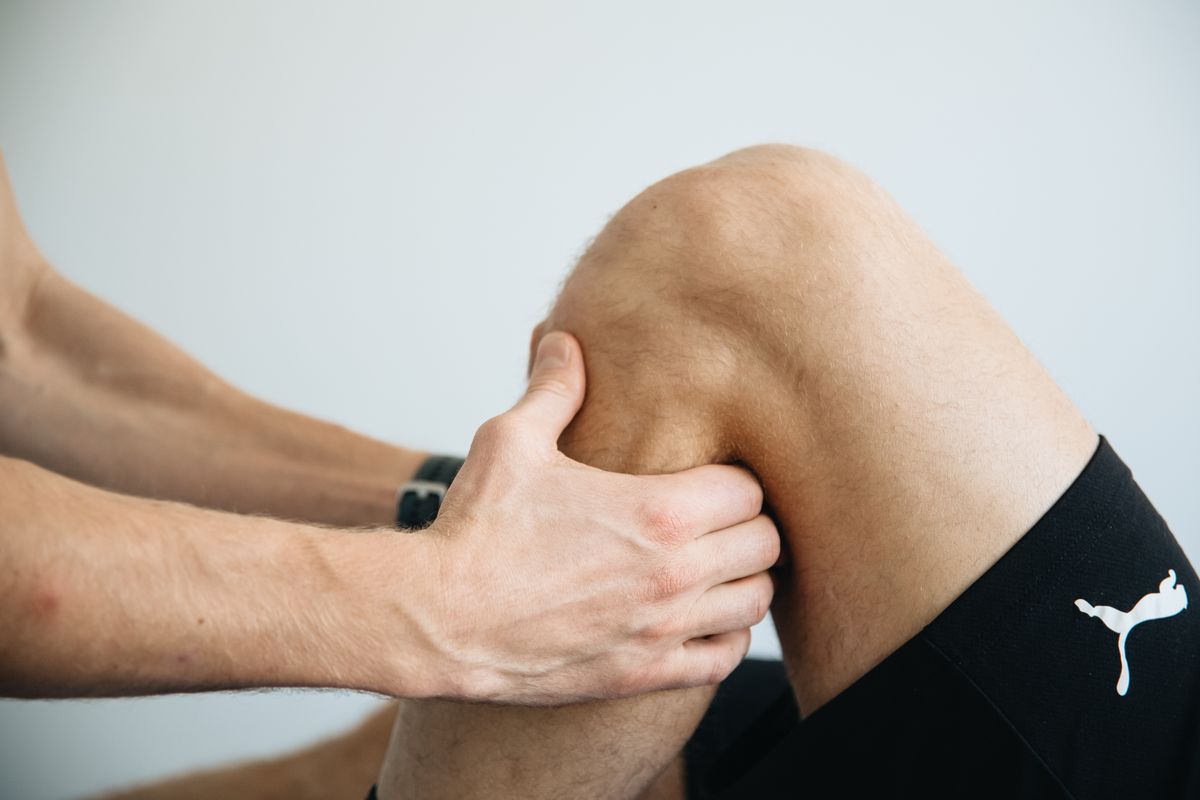
Chronic knee pain. Sixteen patients, single intra-articular injection, retrospective. Fourteen of sixteen reported significant relief lasting six to twelve months.
Those response rates are striking. They are also uncontrolled, unblinded, and total 30 people between them. A registered Phase I trial enrolled 42 subjects in 2015, then was cancelled with no results published. That is why the human picture stops here rather than somewhere more useful.
The cancer question, answered properly
This is the concern that comes up first, and the intuition behind it is sound: a compound that builds blood vessels sounds like a compound that feeds tumours.
A 2025 narrative review looked directly at it. The finding ran opposite to the assumption — in animal tumour models, BPC-157 inhibited uncontrolled cell proliferation and downregulated VEGF expression, appearing to work against tumour-driven angiogenesis rather than for it.
That is reassuring, and it is not the end of the argument. It raises VEGFR2, which is the same receptor tumours exploit to build supply. The review's own conclusion was that human data remains, in its words, exceedingly sparse, and that the compound should be treated as investigational until proper trials exist.
So: no study shows it causes cancer, and animal work points the other way. The honest position is still that active cancer or a recent cancer history rules it out until an oncologist says otherwise. Not because the evidence condemns it. Because the evidence is not there either way, and the downside is not recoverable.
Where the regulators landed
The regulatory picture here is unusually definite for a compound in this category, and it is worth knowing precisely.
WADA added it in 2022 under S0, Unapproved Substances — the category for things with no approval from any health authority anywhere. Seven American sporting bodies ban it separately: the NFL, MLB, NHL, the NCAA and NAIA in college sport, the PGA, and the UFC.
The FDA classified it in September 2023 as a Category 2 bulk drug substance, citing insufficient human safety evidence. That bars compounding pharmacies from using it. The stated concerns are immune reactions, impurities in unregulated product, and the missing human safety data.
It is not approved for human use. It is not legal to sell in the United States as a drug, a food or a dietary supplement. That is a different situation from the "research use only" grey area. This one has been ruled on.
Side effects
Animal work found no acute toxicity across organ systems at doses spanning a thousandfold range, with no hepatic, renal, mutagenic or teratogenic signal. That is a broad clean result. In animals.
Reported effects in people are mild and mostly dose-related. Injection site redness, swelling or soreness, mild nausea at higher doses, dizziness, and fatigue. Less often: mood changes or anxiety, palpitations, disturbed sleep when dosed late, headache and reduced appetite. Most clear within days.
NSAIDs are the one interaction worth flagging, and the data pulls both ways. Some research has BPC-157 protecting the gut against NSAID damage. Other work suggests NSAIDs may interfere with its regenerative signalling. Not a hard rule, but not nothing either.
Beyond active or recent cancer, take care with pregnancy and breastfeeding (no data at all), liver or kidney impairment, heart conditions, and any unresolved mass or precancerous finding.
How to hold all this
The pattern here is worth naming, because it recurs across this field.
Broad, consistent, mechanistically detailed animal evidence is a real reason to take a compound seriously. It is not the same as knowing what it does in people, at what dose, over what period, at what risk. Thirty humans in three uncontrolled pilots does not close that gap, however good the results look.
BPC-157 may well turn out to work as advertised. The point is that today, the confident version of that claim runs well ahead of what anyone has measured.
Scope note
This article explains published research and the rules around it. It carries no dose,
no protocol, and no claim that any compound treats, cures or prevents a condition in
anyone. Where the evidence is thin we say so. See our
editorial standards.
References
- Vasireddi, N. et al. Emerging use of BPC-157 in orthopaedic sports medicine: a systematic review. HSS Journal (2025).
- McGuire, F. P. et al. Regeneration or risk? A narrative review of BPC-157 for musculoskeletal healing. Current Reviews in Musculoskeletal Medicine (2025).
- Hsieh, M. J. et al. Therapeutic potential of pro-angiogenic BPC157 is associated with VEGFR2 activation and up-regulation. Journal of Molecular Medicine 95, 323–333 (2017).
- Chang, C. H. et al. The promoting effect of pentadecapeptide BPC 157 on tendon healing involves tendon outgrowth, cell survival, and cell migration. Journal of Applied Physiology 110, 774–780 (2011).
- Chang, C. H. et al. Pentadecapeptide BPC 157 enhances the growth hormone receptor expression in tendon fibroblasts. Molecules 19, 19066–19077 (2014).
- Huang, T. et al. Body protective compound-157 enhances alkali-burn wound healing in vivo and promotes proliferation, migration, and angiogenesis in vitro. Drug Design, Development and Therapy 9, 2485–2499 (2015).
- Gwyer, D. et al. Gastric pentadecapeptide body protection compound BPC 157 and its role in accelerating musculoskeletal soft tissue healing. Cell and Tissue Research 377, 153–159 (2019).
- Sikiric, P. et al. Novel cytoprotective mediator, stable gastric pentadecapeptide BPC 157: vascular recruitment and gastrointestinal tract healing. Current Pharmaceutical Design 24, 1990–2001 (2018).
- Wang, L. et al. Pharmacokinetics, distribution, metabolism, and excretion of body-protective compound 157 in rats and dogs. Frontiers in Pharmacology 13 (2022).
- Lee, E. & Burgess, K. Safety of intravenous infusion of BPC157 in humans: a pilot study. Alternative Therapies in Health and Medicine 31, 20–24 (2025).
- Lee, E., Walker, C. & Ayadi, B. Effect of BPC-157 on symptoms in patients with interstitial cystitis: a pilot study. Alternative Therapies in Health and Medicine 30, 12–17 (2024).
- World Anti-Doping Agency. Prohibited List, section S0 (unapproved substances).
- US Food and Drug Administration. Category 2 bulk drug substances nominated for use in compounding under section 503A (September 2023).
Where to buy
Nalu Labs
Research-grade material, sold for laboratory research use. We link to a single supplier rather than a list, so you know exactly where the
recommendation goes. Check the certificate of analysis against
what a COA can and cannot show
before you buy anything.
Shop at Nalu Labs →
Commercial link. Nothing on this page is a dose, a protocol, or a
claim that this compound treats or prevents any condition.