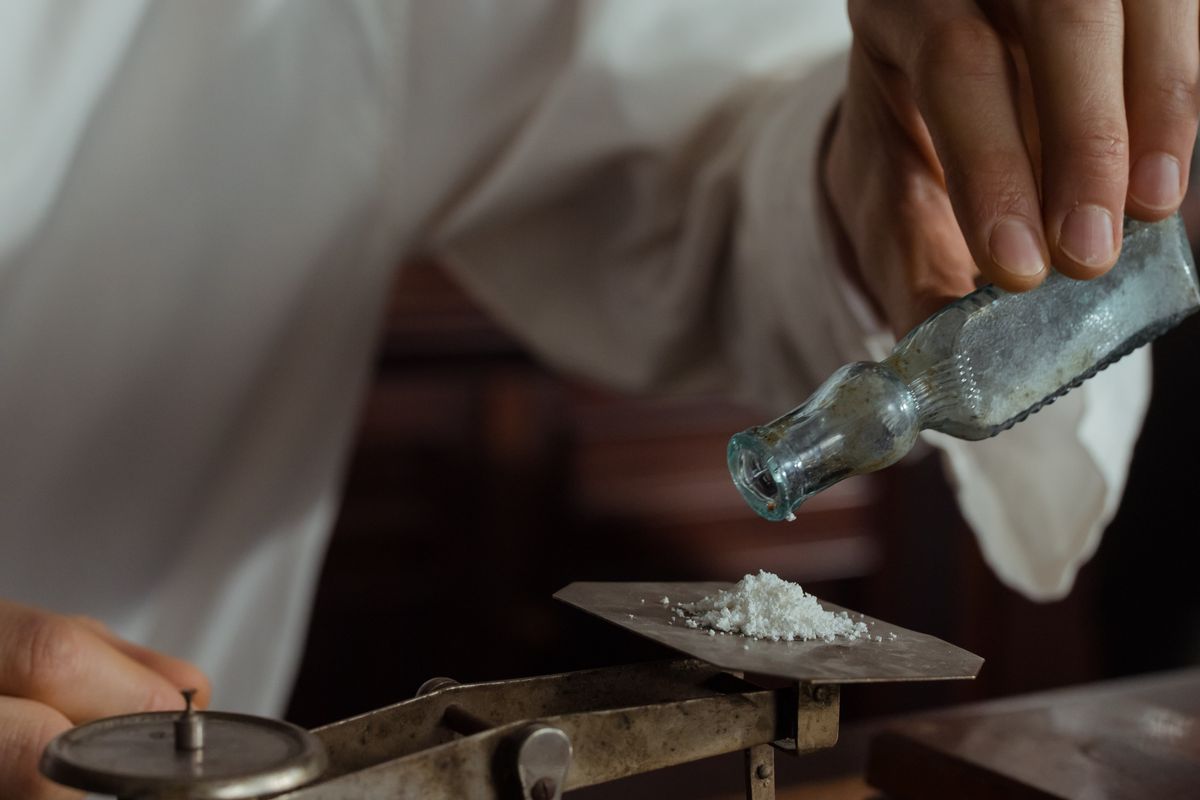
The difference between these two blends takes one line to state. KLOW is GLOW plus 10 mg of KPV. The other three peptides are present in identical amounts, so nothing else changes.
That is the whole answer to the question people ask. It is not the most useful thing you can know about either product.
Weigh the vial instead
Look at what the mass is actually doing.
GLOW      70 mg     GHK-Cu 50  BPC-157 10  TB-500 10
KLOW      80 mg     GHK-Cu 50  BPC-157 10  TB-500 10  KPV 10
GHK-Cu is 71% of GLOW and 63% of KLOW by weight. In GLOW it outweighs everything else in the vial two and a half times over. Even in KLOW, with a fourth peptide added, it still outweighs the other three combined.
These are not really three- and four-peptide products in any balanced sense. They are copper peptide products with modest amounts of three other things alongside.
That reframing matters more than the KPV question, because of what it implies next.
The dominant ingredient is the least-evidenced one
GHK-Cu has genuine randomised human trials behind it — wrinkle depth, skin density, collagen production, all controlled and replicated.
Every one of those trials tested a cream.
There is no published human data at all for injected GHK-Cu, and the FDA moved it to Category 2 in 2023 for that reason. So the compound that makes up most of both vials is the one whose injected use has the least behind it. Meanwhile the well-evidenced version sits on a shop shelf as Copper Tripeptide-1.
That is not an argument against either blend. It is an argument for knowing which part of the vial the research applies to before deciding what to expect.
What each part does, briefly
Each of these has its own article, so this is the short version.
GHK-Cu. Drives collagen I, collagen III and elastin production through gene expression, and delivers the copper that lysyl oxidase needs to cross-link new collagen into something durable. Build the material and supply what locks it together.
BPC-157. Raises VEGFR2 — the receptor, not the signal — so new vessels form and blood reaches the damage. Worth remembering it amplifies a repair signal that has to already be there.
TB-500. Holds actin in reserve and hands it over when a cell needs to travel, letting repair cells reach the site from anywhere in the body.
One naming point, since it affects what you think you are buying. Suppliers describe this component both as the full 43-residue thymosin beta-4 and as a shorter active fragment of it. Those are not the same molecule, and the labels are used interchangeably across the market. If it matters to you, it is worth asking the supplier which one the vial contains.
What KPV actually brings
KPV is three amino acids — lysine, proline, valine — the tail of alpha-MSH.
It inhibits NF-κB, the master switch that turns on a whole set of inflammatory signals at once. And it enters cells through PepT1, the transporter that absorbs tripeptides from food. That second detail is the elegant one: PepT1 is upregulated in inflamed tissue, so inflamed tissue takes up more of it.
Crucially, it keeps alpha-MSH's anti-inflammatory half without the pigment effects. That is not an assumption — it was demonstrated by knockout, with KPV still working in mice that had no functional MC1R receptor. No tanning, no appetite change, no hormonal effect.
It also carries antimicrobial activity against Staphylococcus aureus and Candida albicans. And it appears to raise rather than blunt neutrophil killing. Unlike a steroid, it does not trade inflammation control for weaker defence.
The decision, stated honestly
Vendor comparisons answer this with a list: choose KLOW for rosacea-like patterns, post-laser recovery, gut barrier work; choose GLOW for calm skin and pure collagen goals.
Those recommendations sound precise. They rest on nothing.
Neither blend has ever been studied. Not GLOW, not KLOW, not in any published trial. Every claim about which one suits which situation is extrapolated from single-compound studies — most of them in animals — and then extrapolated again to a combination nobody has tested. Matching a four-peptide vial to a specific skin condition implies a precision that does not exist.
So here is what the evidence will actually support.
The composition difference is a fact. KLOW has one more mechanism in it. If you specifically want NF-κB inhibition and PepT1-mediated delivery to inflamed tissue, only KLOW has it.
The tolerability difference is the best-supported practical advantage. GHK-Cu is cationic, and at an injection site that charge triggers mast cell degranulation and the burning that comes with it. KPV stabilises mast cells. BPC-157 lowers COX-2 and inflammatory cytokines. Reports consistently put KLOW as the most comfortable copper-containing product to inject, and the mechanism explains why.
Notice what that means. Across both blends, the clearest benefit of adding compounds is making the vial easier to tolerate, not making it work better. That is a real benefit. It is not the one the marketing implies.
Everything past that is a judgement call, and it should be made knowing it is one.
What a fourth compound costs
Adding KPV is not free, and comparison charts never list this side.
Every addition widens the contraindication list. Three of the four components build blood vessels. For anyone with a cancer history that is one mechanism of concern arriving three times, in a fixed ratio you cannot adjust. The copper brings Wilson's disease and copper metabolism disorders. KPV brings caution with autoimmune conditions and with other anti-inflammatory medication, where effects may stack.
And the ratio is decided by whoever filled the vial. If the copper peptide is causing you trouble, or you want more of the repair pair and less of it, a blend gives you exactly one lever: the whole dose.
Running the components separately costs more injections and more effort. It buys you the ability to change one thing at a time, and to know which thing did what.
The short version
KLOW is GLOW with one more peptide, and that peptide is the best-characterised mechanism of the four.
Both are, by weight, mostly copper peptide — the ingredient whose injected form has no human trials behind it.
And neither combination has been tested as a combination, so choose on mechanism and on tolerability, which are knowable, rather than on which blend suits which condition, which is not.
Scope note
This article explains published research and the rules around it. It carries no dose,
no protocol, and no claim that any compound treats, cures or prevents a condition in
anyone. Where the evidence is thin we say so. See our
editorial standards.
References
- Pickart, L. & Margolina, A. Regenerative and protective actions of the GHK-Cu peptide in the light of the new gene data. International Journal of Molecular Sciences 19, 1987 (2018).
- Badenhorst, T. et al. Effects of GHK-Cu on MMP and TIMP expression, collagen and elastin production, and facial wrinkle parameters. Journal of Aging Science 4, 166 (2016).
- Maquart, F. X. et al. In vivo stimulation of connective tissue accumulation by the tripeptide-copper complex glycyl-L-histidyl-L-lysine-Cu2+ in rat experimental wounds. Journal of Clinical Investigation 92, 2368–2376 (1993).
- Hsieh, M. J. et al. Therapeutic potential of pro-angiogenic BPC157 is associated with VEGFR2 activation and up-regulation. Journal of Molecular Medicine 95, 323–333 (2017).
- Vasireddi, N. et al. Emerging use of BPC-157 in orthopaedic sports medicine: a systematic review. HSS Journal (2025).
- Malinda, K. M. et al. Thymosin beta4 accelerates wound healing. Journal of Investigative Dermatology 113, 364–368 (1999).
- Xue, B., Leyrat, C., Grimes, J. M. & Robinson, R. C. Structural basis of thymosin-beta4/profilin exchange leading to actin filament polymerization. PNAS 111, E4596–E4605 (2014).
- Dalmasso, G. et al. PepT1-mediated tripeptide KPV uptake reduces intestinal inflammation. Gastroenterology 134, 166–178 (2008).
- Kannengiesser, K. et al. Melanocortin-derived tripeptide KPV has anti-inflammatory potential in murine models of inflammatory bowel disease. Inflammatory Bowel Diseases 14, 324–331 (2008).
- Luger, T. A. & Brzoska, T. Alpha-MSH related peptides: a new class of anti-inflammatory and immunomodulating drugs. Annals of the Rheumatic Diseases 66 (Suppl 3), iii52–55 (2007).
- Brzoska, T. et al. Alpha-melanocyte-stimulating hormone and related tripeptides: biochemistry, antiinflammatory and protective effects in vitro and in vivo. Endocrine Reviews 29, 581–602 (2008).
- US Food and Drug Administration. Category 2 bulk drug substances nominated for use in compounding under section 503A (2023).
Where to buy
Nalu Labs
Research-grade material, sold for laboratory research use. We link to a single supplier rather than a list, so you know exactly where the
recommendation goes. Check the certificate of analysis against
what a COA can and cannot show
before you buy anything.
Shop at Nalu Labs →
Commercial link. Nothing on this page is a dose, a protocol, or a
claim that this compound treats or prevents any condition.