Water splits it, oxygen alters it, or the molecules clump together. Each route leaves a different mark, and no single test catches all three.
By the editors·16 June 2026·3 min read
Three routes, three different marks. A batch can be failing by one while the test you ran watched for another. Illustration: Pexels
A peptide can fail without anyone doing anything wrong. Left alone in a vial, it can come apart in three different ways. Each one leaves a different mark, so no single test finds all three.
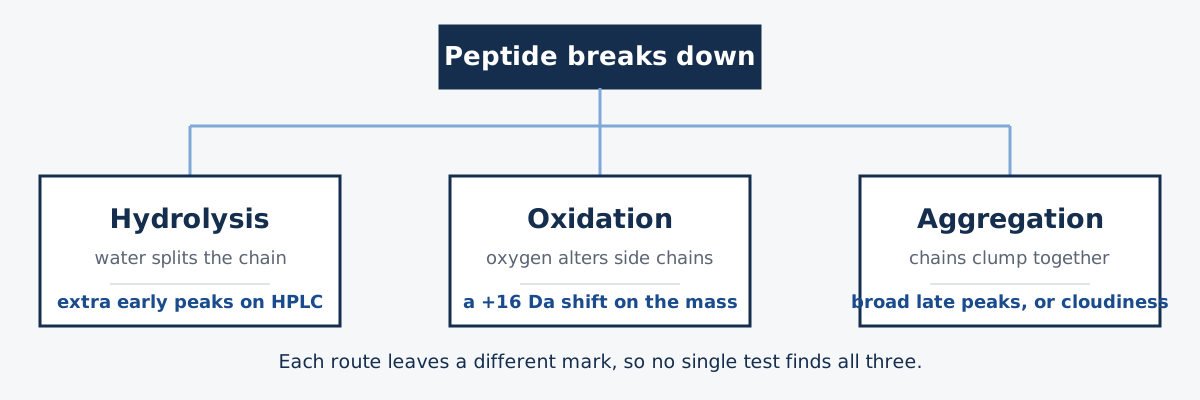
The three routes and the mark each one leaves. A batch can be losing material by one route while every other test still passes.
Hydrolysis: water splits the chain
Water breaks bonds. That is the whole mechanism. It can cut the backbone of the peptide itself, or attack a side chain.
Two spots are far more vulnerable than the rest.
The bond between an aspartate and a proline is unusually weak, and it gives way first. Separately, an asparagine can lose its side-chain amide group and turn into an aspartate. That change is called deamidation, and it adds about 1 Da to the mass.
What speeds it up: water and heat. This is why residual moisture on a certificate of analysis is a stability number, not just a weight number.
How you spot it: the pieces are smaller and more water-loving than the intact peptide, so they come off the column sooner. Hydrolysis shows up as extra peaks arriving earlier than the main one.
Oxidation: oxygen alters the side chains
Three amino acids are sensitive to oxygen: methionine, cysteine, and tryptophan. Dissolved oxygen or trace peroxides react with them and change them chemically.
The peptide is still one piece. Its chain is intact. But it is no longer the same molecule.
What speeds it up: dissolved oxygen, peroxide traces in the solvent, light, and metal ions.
How you spot it: by weight. A single oxygen atom adds 16 Da. That is exactly the +16 Da shift seen on a mass spectrum. It is also the clearest damage a purity chart can miss. An oxidised peptide still absorbs light and still forms a peak.
Aggregation: chains clump together
This one is physical rather than chemical. Nothing is broken and nothing is added. The water-repelling parts of separate molecules find each other and stick. First in pairs, then in larger clusters, and eventually in long fibres.
What speeds it up: high concentration, warmth, and repeated freezing and thawing.
How you spot it: clumps are bigger and stickier than single molecules. So they cling to the column and come off late, as broad smeared peaks rather than sharp ones. The largest clusters may never come off at all. That puts them in the same blind spot as anything else the column keeps. Heavy clumping is also visible without any instrument. The liquid turns cloudy, or solid matter settles out.
Why it matters that there are three
The three routes are found by three different methods. Hydrolysis shows on chromatography. Oxidation shows on the mass. Aggregation shows late on the chart, or in the appearance of the solution.
A batch can be coming apart by one route while the test you ran was watching for another.
Scope note
This article explains published research and the rules around it. It carries no dose,
no protocol, and no claim that any compound treats, cures or prevents a condition in
anyone. Where the evidence is thin we say so. See our
editorial standards.
KLOW is GLOW plus 10 mg of KPV — that part is simple. The more useful fact is that both are, by mass, mostly copper peptide, and that is the ingredient whose injected form has no human trials.
An open study found sleep normalised in six of seven patients. The controlled study by the same investigator found weak effects and said so. The difference between them is a placebo arm.
It does not raise dopamine — it magnifies what other things do to it. That one property explains why caffeine feels stronger on it, and why MAO inhibitors are a hard contraindication.
25 Sep 2026·8 min read
We use Google Analytics to count visits and see which articles get read. It is off until you
turn it on, and we do not use advertising cookies at all.
What we collect.