Tesamorelin is often called "the visceral fat peptide." That name is misleading. Why it stuck says something useful about how reputations form in this field.
Start with the misconception
There is no visceral fat receptor. Tesamorelin does not hunt down belly fat.
It is a GHRH analogue. It binds the same receptor as sermorelin and CJC-1295. It triggers the same pituitary response. It produces the same cascade. Same pathway, same mechanism.
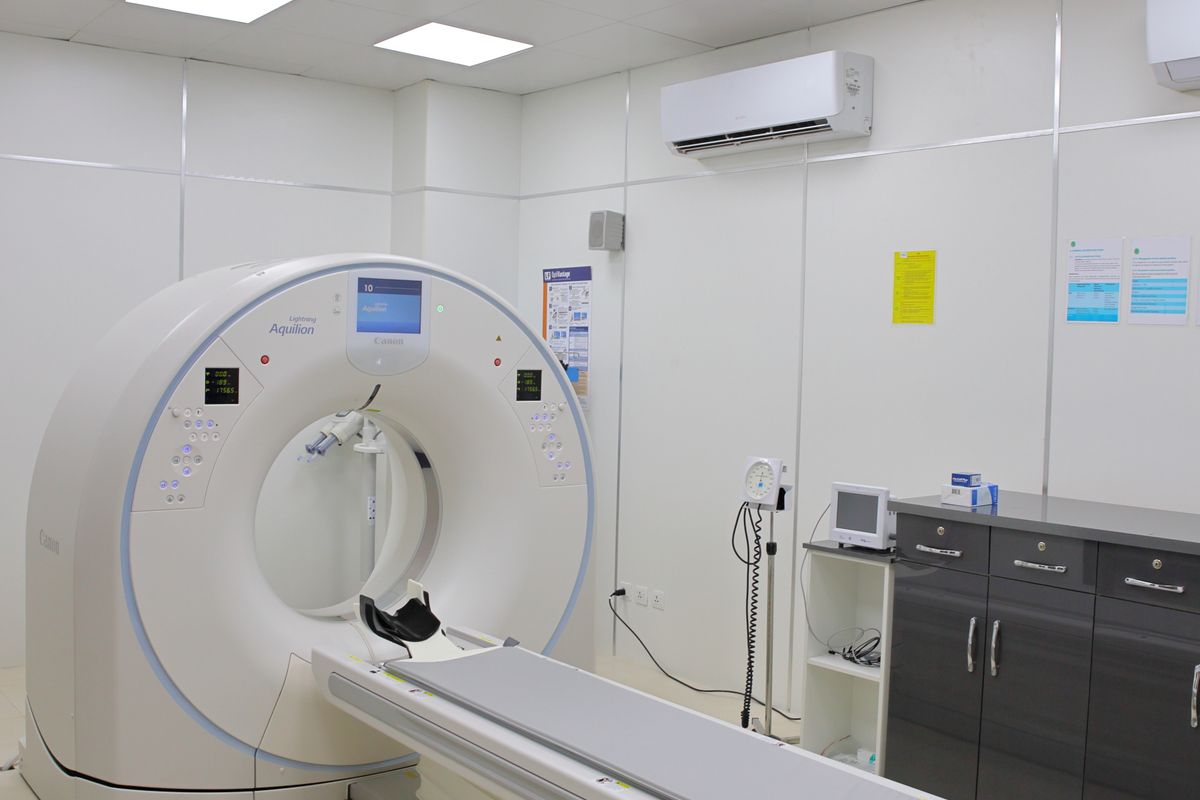
What differs is what got measured. Tesamorelin was developed for one approval: reducing excess belly fat in adults with HIV-associated lipodystrophy. So its trials measured visceral fat by CT scan over 26 weeks. That is the endpoint that won the licence, and the nickname followed the measurement.
Run another GHRH analogue through the same trial design and it would likely show something similar. Nobody funded that study, because nobody was chasing that approval with it. Missing data is not proof of a missing effect. And having data is not proof of a special mechanism.
What it is
Tesamorelin is the full 44-amino-acid GHRH sequence. Not a fragment. It has one addition: a small fatty acid group bolted onto the front end of the chain.
That addition is there to block DPP-4, the enzyme that chops natural GHRH apart. Plain GHRH lasts about two minutes in the blood. Tesamorelin lasts about 26 minutes. Short by most standards, long by comparison.
Theratechnologies developed it. It was approved in 2010 as Egrifta, and a reformulated version was approved in 2024. It is a prescription medicine. WADA bans it under peptide hormones and growth factors.
How the signal behaves
The compound binds GHRH receptors on somatotroph cells in the pituitary. Those cells release growth hormone. Blood levels peak within 30 to 60 minutes. The compound clears fast, but the pituitary response runs on for two to three hours.
IGF-1 climbs slowly and settles after two to four weeks of steady use.
Because it signals rather than substitutes, the body's own brake stays connected. The natural pulse pattern is preserved.
A real tension in the body
One point in the source material for this article is worth pulling out, because it rarely gets said.
Growth hormone release is best when insulin is low and ghrelin is high. That means fasted. But the liver converts growth hormone into IGF-1 better when insulin is present. That means fed.
Those two conditions are opposites. The body solves it by splitting them in time. The big pulse comes during fasted sleep. That hormone stays in the blood for a few hours. Conversion then picks up after the next meal raises insulin.
It is a good example of why timing rules in this field are messier than they look. "Always fasted" answers only half the question.
What the trials found
The pivotal trials (2007, New England Journal of Medicine; 2010, Journal of Acquired Immune Deficiency Syndromes). 412 patients with HIV and belly fat gain, over 26 weeks. Visceral fat fell 15.2% on tesamorelin and rose 5.0% on placebo. Triglycerides dropped about 50 mg/dL. The cholesterol ratio improved. IGF-1 rose 81%, into the middle of the normal range. Lean mass held steady, and blood sugar control did not get worse. In a 12-month extension, people who kept going reached roughly 18%.
Liver fat (Stanley and colleagues, JAMA, 2014, and Lancet HIV, 2019). The later trial is the more striking one. In 61 people with HIV and fatty liver disease, liver fat fell 37% from where it started. 35% of treated people dropped below the 5% mark that defines fatty liver, against 4% on placebo. Scarring also progressed less often.
Meta-analysis (2026, Obesity Research and Clinical Practice). Five randomised trials pooled. Visceral fat down about 27.7 cm². Trunk fat down 1.18 kg. Lean mass up 1.42 kg. Liver fat down 4.28%. No serious harms, and no disturbance to blood sugar.
Cognition (2025, Journal of Infectious Diseases). 73 people with HIV and belly obesity. Waist size fell by a clear margin. But thinking and memory scores did not differ between the groups, and IGF-1 changes tracked nothing on those tests. Worth saying plainly, since brain benefits are sometimes claimed for this compound.
The limit that governs all of the above
Every one of those trials was run in people with HIV. Most had lipodystrophy or fatty liver disease.
There are no large randomised trials of tesamorelin in otherwise healthy adults, for body composition or for ageing. The mechanism supports the leap, and the safety record is reassuring. But someone with HIV-associated metabolic disease is not the same starting point as a healthy adult. Results in one group do not automatically carry to the other.
The storage problem, and why a purity test misses it
This compound behaves unlike almost every other peptide. Get it wrong and the material is ruined.
Once mixed, tesamorelin is kept at room temperature, not in the fridge.
The reason sits in the molecule. That fatty acid group repels water, and the sequence carries many other water-repelling parts. As the temperature drops, those parts on neighbouring molecules start sticking to each other, and the solution turns to gel. This is a property of the molecule itself. It is in every vial, whatever the source.
The approved product includes an excipient called hydroxypropyl betadex. It wraps the water-repelling parts and holds them apart. Research-grade material is the same peptide, usually without that helper. So the room-temperature rule still applies, and the margin may be thinner.
Now the part that ties back to everything else on this site. A standard purity test cannot catch this. Chromatographic purity measures chemical breakdown, meaning whether the chain is still intact. Clumping is a physical change. The chain is fine; the molecules have simply stuck together. Catching that takes dynamic light scattering or size-exclusion chromatography, and neither shows up on a routine certificate of analysis.
So a vial can pass its purity test and still be dead.
The arithmetic worth knowing
The clinical dose of tesamorelin is 2 mg a day. Other GHRH analogues hitting the same receptor are used at a small fraction of that, roughly one or two tenths of a milligram.
Vials of these compounds cost broadly the same. So the same mechanism ends up costing about ten times more when delivered this way. A 5 mg vial lasts around two and a half days at the clinical dose.
That is not an argument that tesamorelin fails to work. The trials say it works. It is an argument that its edge is evidence, not mechanism. What you pay for is the trial data, not a different effect.
Side effects
Injection site reactions are the most common, and stronger than with others in this class. Redness, itching and flushing, usually settling within twenty minutes.
Joint pain, muscle pain, mild fluid retention and tingling also show up across the trials.
One study saw fasting blood sugar rise at two weeks; it had returned to normal by six months. Anyone with existing insulin resistance should treat that as worth watching.
It is not for people with active or past cancer, pituitary disorders or pituitary surgery, previous radiation to the head, or pregnancy. In pregnancy it carries a Category X rating, meaning it should not be used at all.
Scope note
This article explains published research and the rules around it. It carries no dose,
no protocol, and no claim that any compound treats, cures or prevents a condition in
anyone. Where the evidence is thin we say so. See our
editorial standards.
References
- Falutz, J. et al. Metabolic effects of a growth hormone-releasing factor in patients with HIV. New England Journal of Medicine 357, 2359–2370 (2007).
- Falutz, J. et al. Effects of tesamorelin in HIV-infected patients with abdominal fat accumulation: a randomized placebo-controlled trial with a safety extension. Journal of Acquired Immune Deficiency Syndromes 53, 311–322 (2010).
- Stanley, T. L. et al. Effect of tesamorelin on visceral fat and liver fat in HIV-infected patients with abdominal fat accumulation: a randomized clinical trial. JAMA 312, 380–389 (2014).
- Stanley, T. L. et al. Effects of tesamorelin on non-alcoholic fatty liver disease in HIV: a randomised, double-blind, multicentre trial. Lancet HIV 6, e821–e830 (2019).
- Badran, A. S. et al. Body composition, hepatic fat, metabolic and safety outcomes of tesamorelin in HIV-associated lipodystrophy: a meta-analysis of randomized controlled trials. Obesity Research and Clinical Practice (2026).
- Ellis, R. J. et al. Effects of tesamorelin on neurocognitive impairment in persons with HIV and abdominal obesity. Journal of Infectious Diseases 231, 1230–1238 (2025).
- Teichman, S. L. et al. Prolonged stimulation of growth hormone and insulin-like growth factor I secretion by CJC-1295. Journal of Clinical Endocrinology and Metabolism 91, 799–805 (2006).
- Theratechnologies Inc. Egrifta WR (tesamorelin) prescribing information. US Food and Drug Administration (2025).
- World Anti-Doping Agency. Prohibited List, section S2 (peptide hormones, growth factors and related substances).
Where to buy
Nalu Labs
Research-grade material, sold for laboratory research use. We link to a single supplier rather than a list, so you know exactly where the
recommendation goes. Check the certificate of analysis against
what a COA can and cannot show
before you buy anything.
Shop at Nalu Labs →
Commercial link. Nothing on this page is a dose, a protocol, or a
claim that this compound treats or prevents any condition.