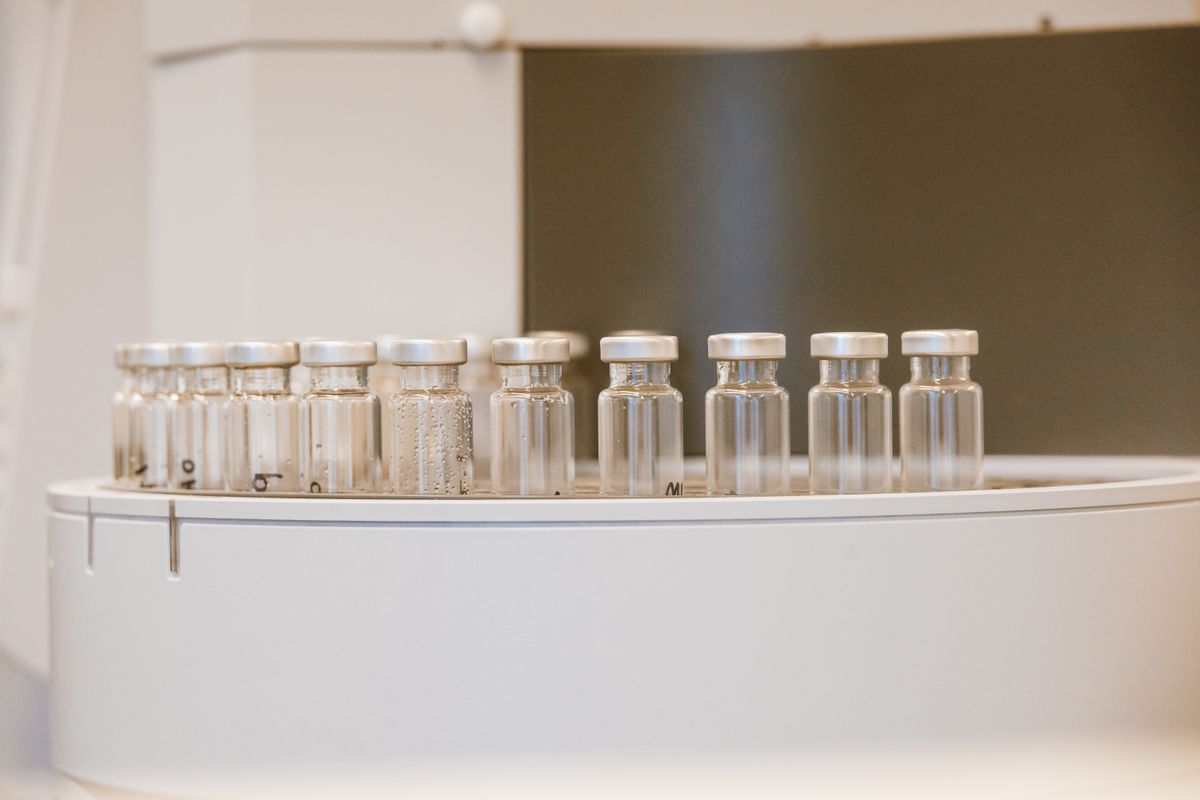
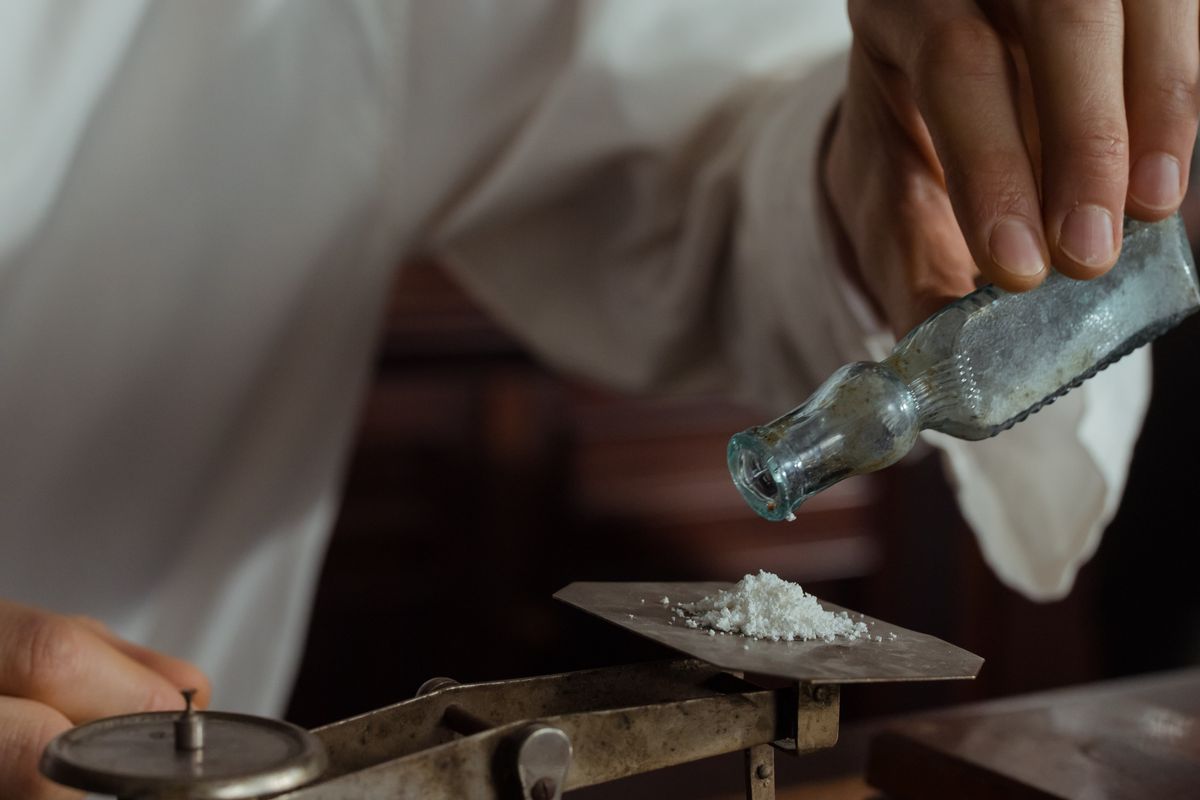
You order 10 mg of a peptide. The vial arrives holding 10 mg of powder. Somewhere between a fifth and a third of that powder is not peptide at all.
None of it is contamination. Every part of it arrives for a reason, put there by the process that made the material. It is simply never counted, because the number everyone quotes does not count it.
What the powder is made of
A typical freeze-dried vial supplied as a TFA salt breaks down roughly like this:
Treat the figures as an illustration rather than a rule. The split moves with the peptide and with how it was finished. The scale is the point. Up to about 30% of the weight you paid for is something other than the molecule you ordered.
Where each part comes from
Trifluoroacetate, or TFA. Peptides are cut off the resin bead with strong acid, and TFA is the usual choice. Basic side chains, meaning lysine, arginine, and histidine, hold a positive charge. The negatively charged trifluoroacetate pairs with them and stays. In a TFA salt it is commonly 10 to 20% of the weight. A sequence rich in those three residues carries more of it.
Acetate or hydrochloride. These are alternatives, swapped in during a second purification step. TFA is known to interfere with cell-based assays. Material meant for that kind of work is often converted for exactly that reason.
Water. Freeze-drying removes most of it, not all of it. Peptide powders also draw moisture back out of the air once a vial is opened.
Solvents. Traces of dimethylformamide (DMF) from the synthesis, acetonitrile from the purification, and diethyl ether from the precipitation and washing steps.
How each one is measured
No single instrument reports all of this. Three separate methods are needed, and none of them is chromatography of the usual kind.
Why none of it appears on a purity chart
Because a purity chart cannot see any of it.
Salts, water, and most leftover solvents have no chromophore. Nothing in them absorbs the light the detector uses. They pass through leaving no peak. They do not lower the purity figure, because they were never part of the comparison.
That is how a vial reads 99% pure and still contains a quarter less peptide than the label weight implies. The purity figure is describing the peptide. The net peptide content is describing the powder.
Two different questions, two different numbers, and only one of them usually gets quoted.
Scope note
This article explains published research and the rules around it. It carries no dose,
no protocol, and no claim that any compound treats, cures or prevents a condition in
anyone. Where the evidence is thin we say so. See our
editorial standards.
References
- United States Pharmacopeia. General Chapter <467>, Residual Solvents.
- United States Pharmacopeia. General Chapter <921>, Water Determination.
- ICH Harmonised Guideline Q3C, Impurities: Guideline for Residual Solvents.