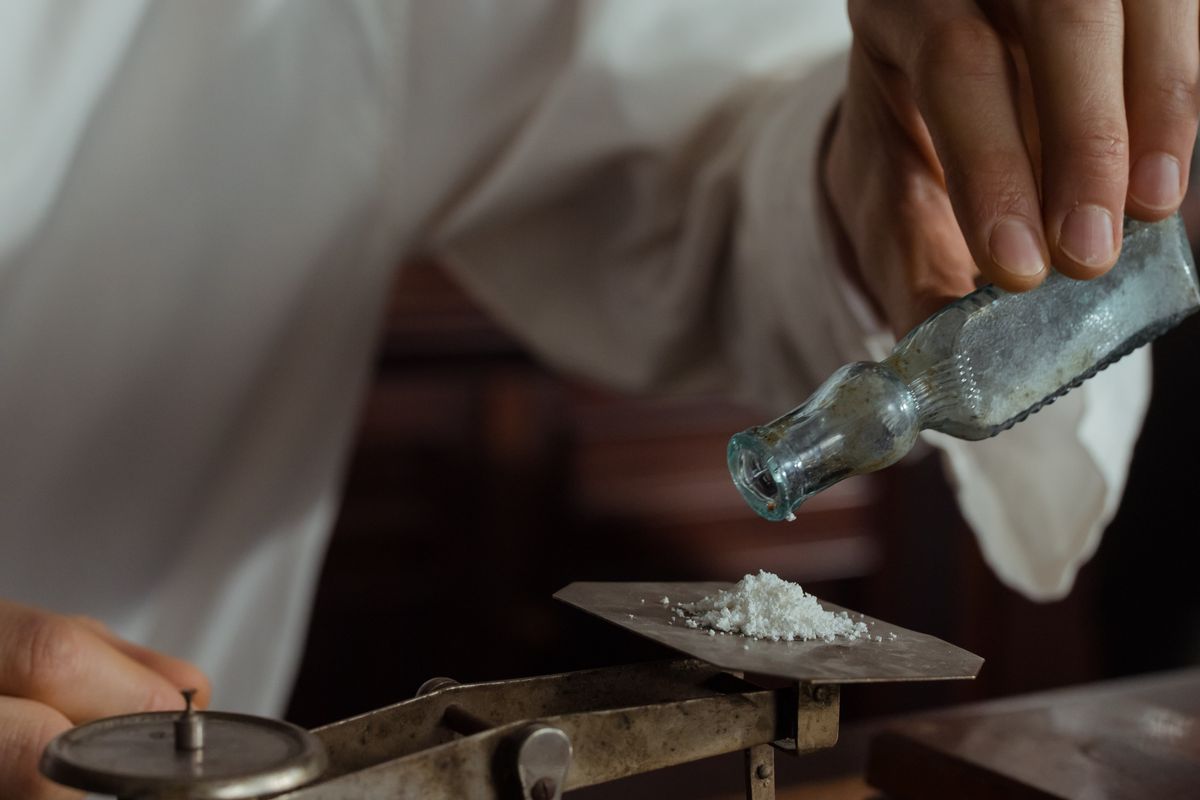
A peptide arrives as a dry cake because dry is how it survives the journey. Freeze-drying removes the water and locks the molecule in a glass-like solid, where chemistry runs very slowly.
Putting that water back is called reconstitution. It is a short procedure. There are only a few ways to get it wrong, and each one has a reason behind it worth knowing.
Do it when you need it, not before
The dry cake is the stable form. A solution is not.
Once the powder is dissolved, the clock starts. The molecule is mobile again, hydrolysis and oxidation resume at a normal pace, and the material needs refrigeration from that point on. Preparing a solution weeks ahead of use trades away the exact stability the freeze-drying was for.
What the liquid is, and why
Bacteriostatic water is the usual choice. It is sterile water containing a small amount of benzyl alcohol, which suppresses bacterial growth. That matters because a vial gets entered more than once, and each entry is an opportunity for contamination.
Plain sterile water for injection has no preservative in it. Some materials call for it instead. That is either because the compound does not get on with benzyl alcohol, or because the preparation is single-use. Which one applies depends on the material, not on preference. Follow what its documentation says.
What must never be used is anything non-sterile. Tap water, filtered water, and opened non-sterile containers all carry organisms. The solution has no way of dealing with them.
Preparing the space
Aseptic technique is not ceremony. Every one of these steps closes a specific route in.
- Wash your hands, then use an alcohol rub. Skin carries organisms that transfer on contact.
- Clean the work surface and lay everything out before starting. Reaching for a forgotten item mid-procedure is when contamination happens.
- Wipe both rubber stoppers with an alcohol pad — the peptide vial and the water. Then let the alcohol dry. Wet alcohol carried through the stopper ends up in the solution.
- Touch nothing that will touch the contents. Not the needle, not the inside of a cap, not the cleaned face of a stopper. If any of them contacts a finger or a surface, that piece is finished.
Adding the liquid
Take the plastic caps off both vials so the rubber stoppers are exposed, then clean them as above.
Draw the volume you calculated. Typically 1 to 2 mL — the trade-off between concentration and measuring precision is worked through in the calculations article.
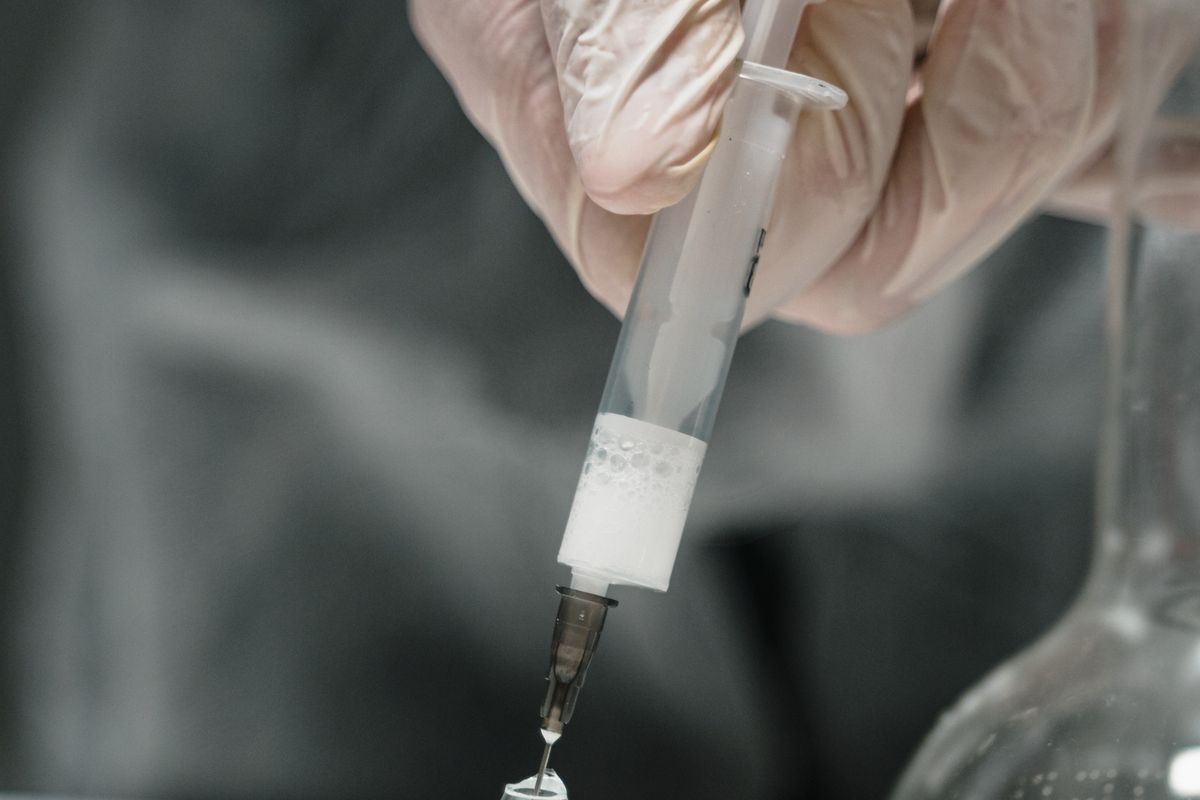
Then the step that matters most. Push the needle through the stopper and point it at the glass wall. The liquid runs down the side and reaches the cake slowly.
Do not fire the stream straight into the powder.
The reason is mechanical. A peptide holds its folded shape through weak forces. A jet of liquid hitting the cake head-on tears at that shape. What you get back is a solution holding damaged and clumped material, which a purity chart may not reveal.
Mixing
Let it stand. Most of the work happens on its own over several minutes.
Swirl gently if it needs help — a slow circular motion, vial upright.
Do not shake. Shaking does two things, both bad. It applies the same shear that direct-jetting does, and it whips air through the liquid. Every bubble is an air-water boundary, and peptides unfold at that boundary, which is a well-known route to aggregation. A vigorously shaken vial can be visibly foamy and chemically worse than it looks.
Check it is actually dissolved. The solution should be clear, with no particles and nothing settled at the bottom. Undissolved material means the concentration is not what your calculation says, because some of the peptide is still solid. Some materials carry a faint colour; cloudiness and visible specks are a different matter.
Write it down
Record the amount of peptide in the vial, the volume added, the resulting concentration, and the date.
This takes fifteen seconds. It prevents the most common error in the whole process: coming back days later and guessing what concentration a vial is. A label on the vial beats a note kept anywhere else.
The five things not to do
- Do not shake. Shear and air bubbles both damage the molecule.
- Do not use non-sterile water. There is no recovering from contamination introduced at this step.
- Do not freeze a made-up solution unless the documentation for that material says to. Ice crystals form and thaw, and that puts the molecule under stress. What redissolves may not be what you started with.
- Do not use expired bacteriostatic water. The preservative is the entire reason for choosing it, and an expiry date is a statement about the preservative.
- Do not combine materials in one vial. You lose control of each concentration. You have also made a mixture whose interactions nobody has studied.
Scope note
This article explains published research and the rules around it. It carries no dose,
no protocol, and no claim that any compound treats, cures or prevents a condition in
anyone. Where the evidence is thin we say so. See our
editorial standards.
References
- United States Pharmacopeia. General Chapter <1151>, Pharmaceutical Dosage Forms — covers lyophilised preparations and their reconstitution.
- United States Pharmacopeia. General Chapter <797>, Pharmaceutical Compounding — Sterile Preparations — the standard for aseptic technique.
- ICH Harmonised Guideline Q1A, Stability Testing of New Drug Substances and Products.