"Stable at room temperature" appears on a lot of peptide listings. It is rarely false. It is just answering a narrower question than most readers assume, over a shorter period than most readers picture.
What freeze-drying actually does
Freeze-drying, or lyophilisation, does not heat the water out. The material is frozen, then put under vacuum, and the ice turns straight from solid to vapour without becoming liquid first. That step is called sublimation.
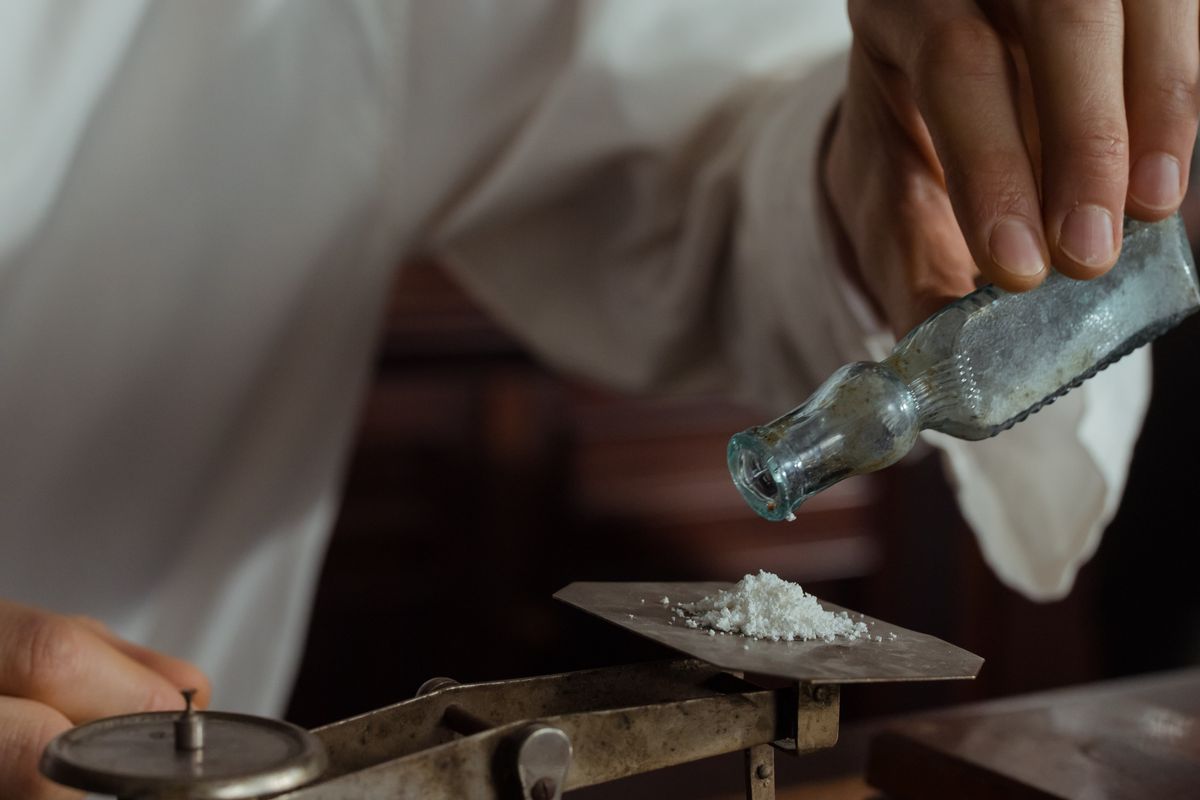
What is left behind is a light, porous solid, usually called the cake. The peptide sits locked inside a glass-like structure, held almost still.
That stillness is the protection. Molecules that cannot move cannot easily react. It slows chemistry down enormously.
It does not stop it. Reactions still run in a dry solid, just slowly. Freeze-drying buys time; it does not freeze time.
What the storage studies varied
Published stability work turns three dials.
Temperature. The standard series runs −80°C, −20°C, 4°C, 25°C, and 40°C. The high end is not a realistic storage condition. It is there to force damage quickly, so a trend can be measured in weeks rather than years.
Matrix integrity. Heat can wreck the cake itself. Once that porous structure slumps, the peptide is no longer held still. More of it is exposed to whatever gas is sealed in the vial above it, and that headspace usually contains oxygen.
Residual moisture. Drying is never total. Water left in the cake at the start feeds slow hydrolysis in the solid state for as long as the vial sits there. This is why the water figure on a certificate of analysis is a stability number, not just a weight number.
What "room temperature stable" usually measured
Here is the part worth reading carefully.
Most work supporting ambient shipping looks at short exposures, typically 3 to 14 days. That is what a parcel goes through in transit. Within that window, most freeze-dried sequences hold up well at 25°C. The claim is sound.
The gap is what happens next. A result covering two weeks in a courier van says nothing about six months on a shelf. Over longer ambient storage, purity loss becomes measurable, and it accumulates through oxidation and aggregation rather than arriving all at once.
Nothing dramatic happens on any single day. That is exactly why it goes unnoticed.
What to ask about a stability claim
- Over what period was it measured, and at what temperature?
- Was the starting moisture content reported?
- Which test tracked the loss? Purity by chromatography will miss oxidation, which shows on the mass.
- Was the cake inspected after the study, or only the liquid it made?
A claim about transit is a claim about transit. It is useful, and it is not a shelf life.
Scope note
This article explains published research and the rules around it. It carries no dose,
no protocol, and no claim that any compound treats, cures or prevents a condition in
anyone. Where the evidence is thin we say so. See our
editorial standards.
References
- ICH Harmonised Guideline Q1A, Stability Testing of New Drug Substances and Products.
- ICH Harmonised Guideline Q5C, Stability Testing of Biotechnological/Biological Products.
- United States Pharmacopeia. General Chapter <1049>, Quality of Biotechnological Products: Stability Testing of Biotechnological/Biological Products.
- United States Pharmacopeia. General Chapter <921>, Water Determination.