A vial of peptide can be ruined before it is ever used, by nothing more than where it was kept. The compound looks the same. The powder is still white. Nothing about the vial announces that half of what you paid for has already broken down.
The rules for avoiding that are short. The reasons behind them are more useful. Learn why each rule exists, and you can work out what to do in cases nobody wrote a rule for.
Why the powder is stable in the first place
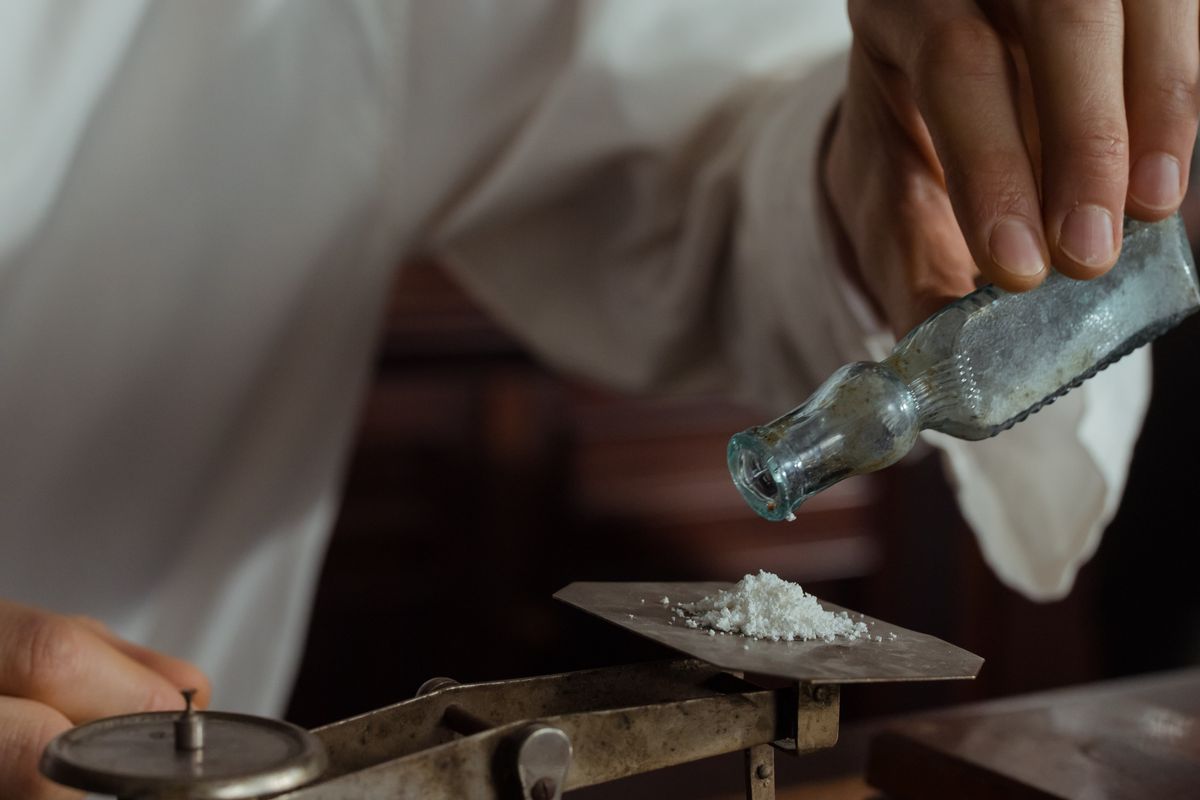
The white cake in the vial was made by freeze-drying. The peptide is frozen, then held under vacuum while the ice turns straight to vapour without ever melting.
Take the water away and the molecules stop moving. They are held in what chemists call a glassy state — rigid, like hard candy, everything locked where it stands. Molecules that cannot move cannot react. A peptide that cannot react does not break down.
That is the whole basis of dry storage. It is why a well-kept powder lasts for years, while the same material in solution lasts weeks.
The four things that break it
Moisture
This is the most important one, and the mechanism is worth following carefully.
The glassy state has a temperature above which it stops being glassy and turns soft. It is called the glass transition temperature, and above it the molecules can move again.
Moisture lowers that temperature. Dramatically.
Nearly dry     glass transition around 80 °C
3% moisture    drops to roughly 50 °C
8% moisture    drops to roughly 25 °C
Read the last line again. At 8% moisture the transition temperature has fallen to about room temperature. A vial sitting on a desk is now above its own transition point. The matrix has softened. The molecules can move. Degradation is running.
This is why you never open a cold vial.
Take a vial from the fridge and pop the cap. The cold surfaces inside pull water out of the air, the way a cold glass sweats on a warm day. That water lands on the powder. You have added moisture, lowered the transition temperature, and started the clock.
Give a cold vial 15 to 30 minutes on the bench, still sealed, before the cap comes off. Once it has reached room temperature there is no difference left to drive condensation. Do not hurry it along with heat.
Heat
Every chemical reaction runs faster when it is warmer, and the relationship is steeper than most people expect.
As a rule of thumb, a 10 °C rise roughly doubles the rate of degradation. Ten degrees warmer is twice as fast. Twenty degrees is four times. Thirty is eight.
That is what refrigeration actually buys. Not a vague sense of care, but a large, specific drop in the speed of every reaction that damages the molecule. It is also why an afternoon on the counter costs more than it feels like it should.
Light
Ultraviolet light drives photooxidation, and one amino acid is far more vulnerable than the rest.
Tryptophan breaks down first. What it turns into is itself light-sensitive. So the molecule becomes more vulnerable to light than it was before. Damage speeds up damage.
Tyrosine, methionine and cysteine are also susceptible.
Keep vials in the dark — the original box is fine. A windowsill is the worst place in the room.
Oxygen
Oxygen attacks the same residues: methionine, cysteine, histidine, tryptophan and tyrosine.
A well-made vial arrives sealed under vacuum, or under an unreactive gas such as nitrogen. There is nothing inside to react with. That protection lasts until the first puncture. Every entry through the stopper lets in a little air, and it stays there.
Which is one reason a half-used vial sitting for months is in worse condition than the calendar suggests.
The two clocks after reconstitution
This is the part that causes the most confusion. Getting it straight settles most of the arguments you will see online.
Adding water starts two separate timers that measure completely different things.
Clock one: microbial safety. Once a stopper has been punctured, organisms can get in. Bacteriostatic water contains 0.9% benzyl alcohol, which suppresses bacterial growth. Note the word — bacteriostatic means it stops bacteria multiplying. It does not kill them.
USP <797> is the pharmaceutical standard for sterile compounding. It gives multi-dose containers with a preservative a limit of 28 days after first entry. That is where the widely quoted figure comes from.
Clock two: chemical stability. This tracks the molecule itself coming apart through hydrolysis, oxidation and aggregation. It has nothing to do with bacteria, and it runs at a completely different speed for every compound.
Here is the point that matters:
The 28-day figure is an infection-risk limit. It is not a statement about whether the peptide still works.
A solution can be perfectly safe from a microbial standpoint and substantially degraded. It can also be chemically intact and contaminated. "How long is this good for?" is really two questions, and only the first one has a standard answer.
What benzyl alcohol does, and does not do
It does two things. It suppresses bacterial growth by disrupting bacterial cell membranes, and it has a mild numbing effect.
It does not prevent chemical degradation. It does nothing about hydrolysis, deamidation, oxidation or aggregation. The preservative protects the solution from organisms; it does not protect the molecule from chemistry.
There is a further wrinkle worth knowing. Benzyl alcohol has been shown to destabilise some proteins, encouraging partial unfolding that leads to aggregation. The effect depends on concentration and on the specific molecule.
So bacteriostatic water is not automatically the better choice. It is the right choice for a container that will be entered repeatedly over days or weeks. For single-day use, plain sterile water or sterile saline avoids the question entirely.
Some compounds do not tolerate it at all. Oxytocin, desmopressin and vasopressin are the clearest documented cases. Sterile water or saline is used for those instead. The IGF-1 peptides are a separate case again. They are unstable near neutral pH, so they are supplied for reconstitution in dilute acetic acid rather than water. In every case the material's own documentation decides, not a general preference.
Never freeze a reconstituted solution
Dry powder in a freezer is fine. A solution in a freezer is not. The reasons are worth spelling out, because "do not freeze it" sounds arbitrary until you know them.
Freezing a solution is not lyophilisation. It is just making ice, and ice damages peptides four ways at once:
- Ice crystals form physical structures that disrupt the molecule.
- Freeze concentration. As water crystallises out, everything dissolved in it is forced into the shrinking liquid that remains. Concentration spikes locally, and high concentration drives aggregation.
- Surface denaturation. Peptides adsorb onto the enormous surface area of ice crystals and unfold there.
- pH shifts. Buffer components crystallise at different rates, so the acidity of the remaining liquid moves while it freezes.
If something is frozen by accident, thaw it at room temperature, use it soon, and do not refreeze. Some loss should be assumed.
What looking at it tells you, and what it does not
A reconstituted solution should be clear, with no particles and no haze.
- Cloudiness means aggregation — molecules clumping.
- Visible particles mean that clumping has advanced far enough to see.
- Yellowing suggests oxidation or other breakdown.
- A gel means severe aggregation.
Any of those is a reason to discard the vial.
But the limit matters. A clear solution is not evidence of potency. Chemical damage happens at a scale you cannot see. A peptide can break into inactive fragments while the liquid stays perfectly clear. Inspection catches gross failure. It cannot confirm that anything still works.
What is actually known here
This deserves stating plainly, because it applies to every storage figure you will encounter, including the ones above.
Research compounds do not come with the stability programmes behind approved medicines. Nobody has run multi-year studies on most of them. The storage numbers circulating online are usually one of three things. Extrapolation from general peptide chemistry. Limited data from a manufacturer. Or the USP <797> microbial limit, repeated as though it described chemical stability.
What is genuinely well established:
- Cold slows every degradation route. This is basic chemistry and it applies universally.
- Light damages specific residues, tryptophan first.
- Freezing a solution causes damage, by the four mechanisms above.
- Without a preservative, organisms grow in an entered container.
- 28 days is a conservative microbial limit from a recognised standard.
What varies by compound, and is often unknown:
- How fast the molecule itself degrades in solution.
- The pH and buffer conditions it prefers.
- Which degradation route dominates for that sequence.
What no guide can tell you:
- How much activity a particular vial has left today.
- Whether your handling has already cost you something.
Where sources disagree, the shorter figure is the safer assumption. Where there is no figure at all, treat the material conservatively rather than optimistically. And anything showing visible change should be discarded regardless of what the calendar says.
Scope note
This article explains published research and the rules around it. It carries no dose,
no protocol, and no claim that any compound treats, cures or prevents a condition in
anyone. Where the evidence is thin we say so. See our
editorial standards.
References
- United States Pharmacopeia. General Chapter <797>, Pharmaceutical Compounding — Sterile Preparations.
- United States Pharmacopeia. General Chapter <51>, Antimicrobial Effectiveness Testing.
- ICH Harmonised Guideline Q1A, Stability Testing of New Drug Substances and Products.
- ICH Harmonised Guideline Q1B, Photostability Testing of New Drug Substances and Products.
- United States Pharmacopeia. General Chapter <1151>, Pharmaceutical Dosage Forms.