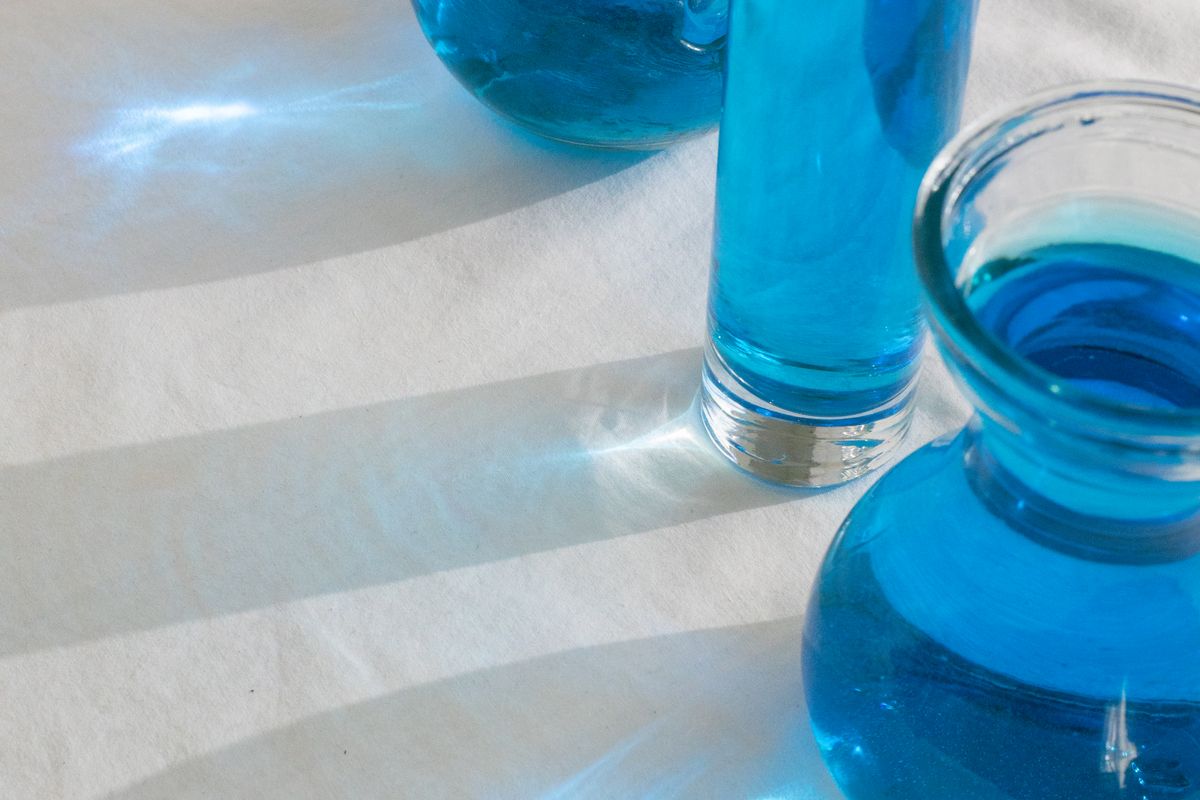
The three compounds in this vial have already been covered separately on this site. What has not been covered is the idea of putting them together, and that idea deserves examining on its own terms — because it is a claim, and it is not the same claim as any of the three underneath it.
Stack the inferences and count them
Here is where each component's evidence actually stops.
BPC-157: over a hundred animal studies, three small human pilots totalling about thirty people, and a Phase I trial cancelled without publishing.
TB-500: human safety trials, plus a Phase II in dry eye. Nothing published in humans on tendon, ligament or muscle.
GHK-Cu: randomised human trials — all of them topical. No published human data on the injectable route at all.
Now add a fourth claim, one that belongs to the blend and nothing else: that these three combine well. No study has looked at this combination. Not a synergy study, not an outcome study, nothing.
The source material for this article puts it better than most vendors would. The combined effect could be additive. It could be synergistic. Or it could come out less than expected. That third option is rarely mentioned anywhere, and naming it is to the source's credit.
So the case for the blend is three extrapolations carrying a fourth that has no support of its own. That does not make it wrong. It makes it a stack of assumptions, and the length of that stack is the thing to be aware of.
Where the reasoning is strongest
The mechanistic argument is genuinely tidy, and it is worth laying out properly rather than dismissing.
BPC-157 opens the supply line. It raises VEGFR2, the receptor rather than the signal, so cells hear repair instructions that are already being sent. New vessels form. Oxygen, nutrients and immune cells reach the damage.
TB-500 moves the workforce. It holds actin in reserve and hands it over when a cell needs to travel. And because it binds nothing in the surrounding matrix, it reaches tissue far from the injection.
GHK-Cu supplies the materials and checks the work. The copper feeds lysyl oxidase. That enzyme locks collagen and elastin fibres together into something durable, and without it new collagen stays weak. It also balances the enzymes that break collagen down against their natural blockers, so old material clears while new goes in.
Supply line, workforce, materials. Three different jobs, three different pathways, minimal overlap. If you were designing a healing stack from mechanism alone, it would look roughly like this.
The catch is that a tidy mechanism is an argument for testing a combination. It is not a substitute for having tested it.
The overlap that is not a feature
One line in the source describes all three promoting angiogenesis through different routes as broad coverage from several angles.
That framing works for benefit. It does not work for risk.
Three compounds building blood vessels is one mechanism of concern, repeated three times. For anyone with an active or recent cancer, these are not three small separate risks that might cancel out. It is the same problem arriving from three directions at once, in a fixed dose you cannot turn down.
That is the strongest argument in the article against casual use of a blend rather than components.
What a blend costs you
Three practical consequences follow from fixing the ratio in a vial, and they get less attention than the convenience.
You cannot adjust one without the others. The ratio was decided by whoever filled the vial. If GHK-Cu is causing you trouble, or you want more of the healing pair and less copper, the blend gives you one lever: the whole dose.
It gives up BPC-157's placement argument. BPC-157 clears in under 30 minutes, which is the basis for injecting it near an injury. TB-500 travels anywhere and does not care. In a blend, one site has to serve both. Fine if you are treating the whole body. Less so for one tendon.
It inherits an unmeasured number. The dosing logic quoted for TB-500 leans on a half-life of roughly ten days. As covered in its own article, that figure has no published pharmacokinetic study behind it. The blend does not fix that; it just carries it along.
The one thing blending genuinely does
There is a real benefit here, and it is not about healing.
GHK-Cu is cationic — positively charged — and at an injection site that charge triggers mast cell degranulation. Histamine is released, and the result is the burning, redness and welting that is the single most reported experience with the standalone compound.
BPC-157 lowers COX-2 expression and inflammatory cytokines. Put them in the same vial and the reaction is, by consistent report, milder. Some people who welted badly on standalone GHK-Cu report no visible reaction from the blend.
This is anecdote, not a published finding. But the mechanism is coherent, the reports are consistent, and it explains something specific.
It is worth sitting with what that means: the best-supported advantage of combining these three is tolerability, not efficacy. Fewer injections and less burning are real benefits. They are not evidence that the combination heals better than its parts.
The blue-green colour, incidentally, is just the copper. A vial that is not tinted would be the one worth questioning. Cloudiness or floating particles are a different matter and mean do not use.
Who should not use it
The contraindications are the union of all three, and the union is wider than any one of them.
Active cancer or tumours — for the angiogenesis reason above, tripled. Any cancer history needs an oncologist's clearance first.
Wilson's disease or any copper metabolism disorder, from the GHK-Cu. Active infection, because copper can support bacterial growth. Hypersensitivity to any of the three, including copper.
Caution with pregnancy and breastfeeding, where not one of the three has safety data. Also with liver or kidney impairment, serious heart conditions, autoimmune disease, and immunosuppressant medication.
On NSAIDs the data pulls both ways, as it does for BPC-157 alone: some work has it protecting the gut against NSAID damage, other work suggests NSAIDs interfere with the regenerative signalling.
Reported effects are mostly mild and dose-related: site reactions, some fatigue, occasional nausea at higher doses, headache, a metallic taste from the copper, blue-green discolouration at the site.
How to think about it
There is a straightforward version of this.
If you would take all three anyway, a blend is one injection instead of three, one reconstitution instead of three, and probably less burning. Those are real conveniences and there is no evidence the compounds interfere with each other.
If you are choosing the blend because three compounds sounds more thorough than one, that reasoning is worth a second look. Each extra component brings its own contraindications and its own unknowns. In this case it also brings another copy of the same blood-vessel mechanism. It also makes it impossible to tell which one is responsible for anything you notice, good or bad.
And every published result quoted in support of this vial was produced by testing one compound at a time.
Scope note
This article explains published research and the rules around it. It carries no dose,
no protocol, and no claim that any compound treats, cures or prevents a condition in
anyone. Where the evidence is thin we say so. See our
editorial standards.
References
- Vasireddi, N. et al. Emerging use of BPC-157 in orthopaedic sports medicine: a systematic review. HSS Journal (2025).
- McGuire, F. P. et al. Regeneration or risk? A narrative review of BPC-157 for musculoskeletal healing. Current Reviews in Musculoskeletal Medicine (2025).
- Hsieh, M. J. et al. Therapeutic potential of pro-angiogenic BPC157 is associated with VEGFR2 activation and up-regulation. Journal of Molecular Medicine 95, 323–333 (2017).
- Chang, C. H. et al. The promoting effect of pentadecapeptide BPC 157 on tendon healing involves tendon outgrowth, cell survival, and cell migration. Journal of Applied Physiology 110, 774–780 (2011).
- Malinda, K. M. et al. Thymosin beta4 accelerates wound healing. Journal of Investigative Dermatology 113, 364–368 (1999).
- Bock-Marquette, I. et al. Thymosin beta-4 activates integrin-linked kinase and promotes cardiac cell migration, survival and cardiac repair. Nature 432, 466–472 (2004).
- Ruff, D., Crockford, D., Girardi, G. & Zhang, Y. A randomized, placebo-controlled, single and multiple dose study of intravenous thymosin beta4 in healthy volunteers. Annals of the New York Academy of Sciences 1194, 223–229 (2010).
- Wang, X. et al. A first-in-human, randomized, double-blind, single- and multiple-dose, phase I study of recombinant human thymosin beta4 in healthy Chinese volunteers. Journal of Cellular and Molecular Medicine 25, 8222–8228 (2021).
- Pickart, L. & Margolina, A. Regenerative and protective actions of the GHK-Cu peptide in the light of the new gene data. International Journal of Molecular Sciences 19, 1987 (2018).
- Maquart, F. X. et al. In vivo stimulation of connective tissue accumulation by the tripeptide-copper complex glycyl-L-histidyl-L-lysine-Cu2+ in rat experimental wounds. Journal of Clinical Investigation 92, 2368–2376 (1993).
- Finkley, M., Appa, Y. & Bhandarkar, S. Copper peptide and skin. In Cosmeceuticals and Active Cosmetics (Marcel Dekker, 2005), 549–563.
- US Food and Drug Administration. Category 2 bulk drug substances nominated for use in compounding under section 503A (2023).
- World Anti-Doping Agency. Prohibited List, section S0 (unapproved substances).
Where to buy
Nalu Labs
Research-grade material, sold for laboratory research use. We link to a single supplier rather than a list, so you know exactly where the
recommendation goes. Check the certificate of analysis against
what a COA can and cannot show
before you buy anything.
Shop at Nalu Labs →
Commercial link. Nothing on this page is a dose, a protocol, or a
claim that this compound treats or prevents any condition.