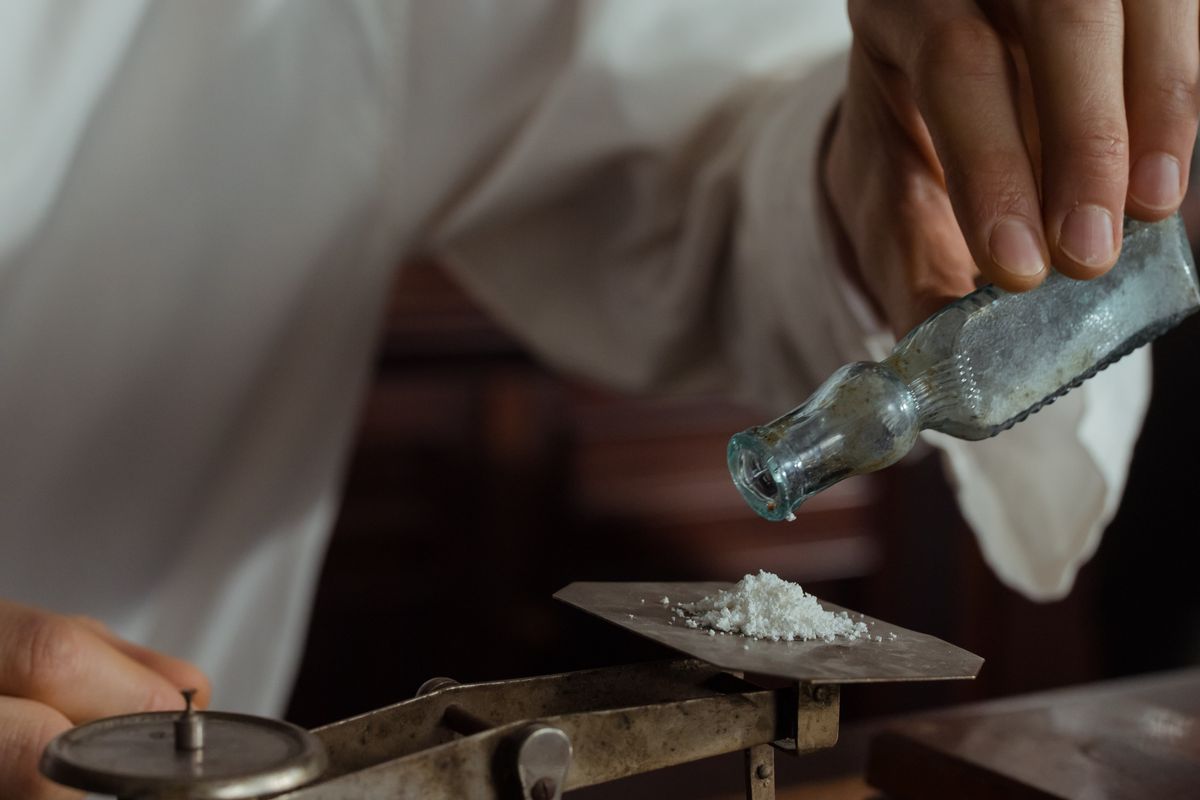
"CJC-1295" names two different drugs. They share a core, and they behave nothing alike.
One clears in about half an hour. The other stays active for the better part of a week. Treating them as one drug with a scheduling choice is the most common mistake made here. It also hides a better question underneath.
The two versions
Without DAC, also sold as Mod GRF 1-29, is the trimmed GHRH molecule. Researchers found that only the first 29 of GHRH's 44 amino acids are needed to switch on the pituitary receptor. They kept those 29 and replaced four residues: the second, the eighth, the fifteenth and the twenty-seventh.
Each swap does a job. Position 2 blocks DPP-4, the enzyme that chops natural GHRH apart. Positions 8 and 27 stop two chemical breakdown routes, deamidation and oxidation. Position 15 raises activity.
Natural GHRH lasts about two minutes. This version lasts about 30. It makes a sharp rise, then clears, and levels come back down.
With DAC takes that same modified peptide and bolts on a Drug Affinity Complex. The DAC lets the peptide latch onto albumin, a carrier protein in the blood that shields it from breakdown. Active life goes from 30 minutes to six to eight days.
So one produces a spike. The other produces a plateau.
Both came from ConjuChem, a Canadian biotech. Neither is approved for anything.
The inversion worth knowing
Here is the part that gets skipped.
The version with human trial data is the one most people do not use. The version most people use has never been through a human trial.
CJC-1295 with DAC went through published, placebo-controlled studies in healthy adults, and then into Phase 2. CJC-1295 without DAC has no published human clinical trials at all. Its case rests on sharing a mechanism with the version that was tested, plus the general pharmacology of GHRH analogues.
The community preference runs the other way, for a fair reason. The short version keeps the natural pulse, and it lets you back out of a problem in an hour instead of a week. But that preference is a mechanistic argument, not an evidential one. It is worth being clear about which kind of argument you are relying on.
How the system it plugs into works
Two signals control growth hormone release, and they are separate.
GHRH comes from the hypothalamus. It tells somatotroph cells in the pituitary to build growth hormone and ship it. Think of it as the order to the factory.
Ghrelin, the hunger hormone from the stomach, hits a completely different receptor, GHS-R1a. It does two things at once. It releases what is already stored, and it shuts off somatostatin, the brake on the whole system. Think of it as emptying the warehouse and lifting the brake together.
Fire both at once and the response is larger than the two added up. In animal work, combined GHRH and ghrelin-pathway dosing produced peaks two to five times higher than simple addition predicts. This is also why your biggest natural pulse arrives in deep sleep: insulin is low, ghrelin is high, and GHRH is firing.
Then comes the loop that keeps it honest. Growth hormone reaches the liver, which converts it into IGF-1. IGF-1 does most of the actual work — protein synthesis, fat mobilisation, repair, collagen. When IGF-1 climbs high enough, the hypothalamus notices and releases somatostatin, and production slows.
CJC-1295 only touches the first signal. It orders more production. It does not empty the warehouse and it does not lift the brake. That is the whole reason it gets paired with a ghrelin agonist like ipamorelin — one compound per pathway.
Why signalling beats substituting
Because it works through the signal, your pituitary still sets the size of the response. Somatostatin still hits the brake when IGF-1 rises. The feedback loop stays connected.
Injecting growth hormone directly skips the pituitary. The body reads the high levels and shuts its own production down. Injecting IGF-1 skips further ahead again, and adds receptor desensitisation on top.
There is a hard consequence to this, and it is a money argument. If you are already on exogenous growth hormone, a GHRH analogue has almost nothing left to do. After a single dose of exogenous growth hormone, GHRH-pathway response was inhibited by roughly 86%, because somatostatin was already up. The secretagogue is shouting at a pituitary that has been told to stop. Running both is not a stack. It is one compound cancelling the other.
What the trials found
Teichman and colleagues, 2006 (Journal of Clinical Endocrinology and Metabolism). Two randomised, placebo-controlled, double-blind trials of the DAC version, in healthy adults aged 21 to 61. One was a single-dose study over 28 days. The other was a repeat-dose study over 49 days. A single injection raised growth hormone two- to tenfold for six days or more. IGF-1 rose one and a half to threefold for nine to eleven days. Half-life came out at 5.8 to 8.1 days. With repeat dosing, IGF-1 stayed above baseline for up to 28 days, and the effect accumulated. No serious adverse reactions.
Small samples, and nothing beyond 49 days.
Ionescu and Frohman, 2006 (same journal). This one asked whether continuous stimulation would flatten the natural pulse. It did not, quite. Pulse frequency and size held steady. What changed was the floor: trough levels rose 7.5-fold, while overall growth hormone rose 46% and IGF-1 rose 45%.
That result is usually quoted as "pulsatility is preserved," which is true but incomplete. The rise in IGF-1 came mainly from lifting the valleys, not from raising the peaks. The DAC version does not give you more of your natural pattern. It gives you your natural pattern sitting on a higher shelf.
Alba and colleagues, 2006 (American Journal of Physiology). Mice bred without GHRH signalling. Daily dosing brought growth back to normal; every 48 or 72 hours improved it but did not. Pituitary growth hormone mRNA rose, suggesting somatotroph cells had multiplied. Animal work in mice missing a system humans still have.
Jetté and colleagues, 2005 (Endocrinology). The paper that identified the albumin-binding mechanism. In rats, a fourfold increase in growth hormone exposure over two hours against plain GRF 1-29, still detectable past 72 hours.
Raun and colleagues, 1998 (European Journal of Endocrinology). Not about CJC-1295, but it explains its usual partner. Ipamorelin was the first ghrelin-pathway compound to raise growth hormone without dragging cortisol, ACTH and prolactin up too. That held even at 200 times its working dose. Older options like GHRP-6 and GHRP-2 worked but pushed stress hormones up too.
The trial that stopped
The DAC version reached Phase 2 for HIV-related lipodystrophy, with 192 participants enrolled across sites in North and South America.
It was halted in July 2006. A participant at a site in Argentina died, reportedly a few hours after an eleventh injection. The attending physician concluded the most likely cause was undiagnosed coronary artery disease, with plaque rupture and blockage, unrelated to the peptide. No causal link to the compound was established.
Development was never restarted. That is the reason the human data stops where it does, and it is worth stating plainly rather than leaving it as a gap.
The prerequisite nobody wants to hear
Growth hormone and IGF-1 support protein synthesis. IGF-1 binds its receptor on muscle cells and ends up switching on mTOR.
But that cascade needs sex hormone signalling to run. Block androgen receptor signalling and the downstream IGF-1 response shuts down. Testosterone directly raises IGF-1 expression inside muscle tissue. In women, oestrogen decides whether muscle can answer an anabolic signal at all. Postmenopausal women without replacement do not get the normal muscle-building response to training. Restore the oestrogen and the response comes back.
The practical version: with low sex hormones, the money goes into amplifying a signal the tissue has no way to hear. Blood work first. This is the cheapest thing on the list and the one most often skipped.
Sleep, and the order things arrive in
GHRH affects sleep directly, not only through growth hormone. It lengthens and deepens slow-wave sleep — the same phase in which the largest natural pulse occurs.
That is why sleep is almost always the first thing people report, usually within one to two weeks. It is also the only early signal you get. Body composition moves on a much longer clock. Fat loss driven this way is slower than what a diet or a GLP-1 agonist gives you, though it favours visceral fat and spares lean tissue. Connective tissue and skin changes take months.
Anyone expecting a fast visible result from this class has misread the timescale.
Two rules that follow from the mechanism
Do not run two GHRH analogues together. CJC-1295, tesamorelin and sermorelin all bind the same receptor on the same cells. A second one adds nothing but cost. One compound per pathway is the whole idea.
The 5-on, 2-off schedule does not match any known desensitisation timeline. Short-term receptor fatigue resolves in about an hour. The chronic kind, going by the hexarelin work, takes roughly 16 weeks to develop and about four weeks off to reverse. Two days addresses neither. Meanwhile the tesamorelin trials that won FDA approval dosed daily for 26 weeks. A two-year MK-677 study dosed daily throughout, and growth hormone and IGF-1 stayed up.
A schedule that makes a month's supply last six weeks is a good schedule for whoever sells the vial. It is not derived from the biology.
Side effects
Injection site reactions are the most common: redness, swelling, irritation. The flushing is the other signature — warmth, a head rush, sometimes a brief rise in heart rate right after injection. Water retention shows up at higher doses, along with headache and transient tingling in the hands and feet.
The two versions fail differently. With the short version, a problem clears in an hour, so the next dose can simply be smaller. With DAC, a bad reaction is with you for six to eight days. There is nothing to adjust in the meantime. That asymmetry deserves more weight than it usually gets when people compare the two on convenience alone.
Anything that raises growth hormone can in time bring joint pain or stiffness, carpal tunnel symptoms, swelling in the hands, feet or face, and shifts in blood sugar. Those are signals that levels have gone too high.
Who should not use it
Active cancer or tumours is the firm one — growth hormone and IGF-1 can speed tumour growth. A cancer history needs an oncologist's input. Diabetic retinopathy can get worse. Known hypersensitivity rules it out.
Take care with diabetes or pre-diabetes, heart disease (more so with the DAC version, which holds levels up), a history of carpal tunnel syndrome, and liver or kidney disease. There is no safety data in pregnancy or breastfeeding.
For interactions: glucocorticoids such as prednisone and dexamethasone blunt the growth hormone response. Insulin and diabetes medications may need adjustment, with a physician. And exogenous growth hormone or IGF-1, as above, largely cancels the compound out.
The one objective check available is IGF-1 on blood work, before starting and again a few weeks in. Sleep tells you something is happening. IGF-1 tells you whether the pathway actually moved.
Scope note
This article explains published research and the rules around it. It carries no dose,
no protocol, and no claim that any compound treats, cures or prevents a condition in
anyone. Where the evidence is thin we say so. See our
editorial standards.
References
- Teichman, S. L. et al. Prolonged stimulation of growth hormone and insulin-like growth factor I secretion by CJC-1295, a long-acting analog of GH-releasing hormone, in healthy adults. Journal of Clinical Endocrinology and Metabolism 91, 799–805 (2006).
- Ionescu, M. & Frohman, L. A. Pulsatile secretion of growth hormone persists during continuous stimulation by CJC-1295, a long-acting GH-releasing hormone analog. Journal of Clinical Endocrinology and Metabolism 91, 4792–4797 (2006).
- Alba, M. et al. Once-daily administration of CJC-1295, a long-acting GHRH analog, normalizes growth in the GHRH knockout mouse. American Journal of Physiology: Endocrinology and Metabolism 291, E1290–E1294 (2006).
- Jetté, L. et al. Human growth hormone-releasing factor (hGRF)1-29-albumin bioconjugates activate the GRF receptor on the anterior pituitary in rats: identification of CJC-1295 as a long-lasting GRF analog. Endocrinology 146, 3052–3058 (2005).
- Raun, K. et al. Ipamorelin, the first selective growth hormone secretagogue. European Journal of Endocrinology 139, 552–561 (1998).
- Rahim, A. & Shalet, S. M. Does desensitization to hexarelin occur? Growth Hormone and IGF Research 8 (Suppl A), 141–143 (1998).
- Bowers, C. Y., Sartor, A. O., Reynolds, G. A. & Badger, T. M. On the actions of the growth hormone-releasing hexapeptide, GHRP. Endocrinology 128, 2027–2035 (1991).
Where to buy
Nalu Labs
Research-grade material, sold for laboratory research use. We link to a single supplier rather than a list, so you know exactly where the
recommendation goes. Check the certificate of analysis against
what a COA can and cannot show
before you buy anything.
Shop at Nalu Labs →
Commercial link. Nothing on this page is a dose, a protocol, or a
claim that this compound treats or prevents any condition.