Four steps on a plastic bead, repeated once per amino acid. The impurity that is hardest to detect is created by the same loop that builds the peptide.
By the editors·28 July 2026·3 min read
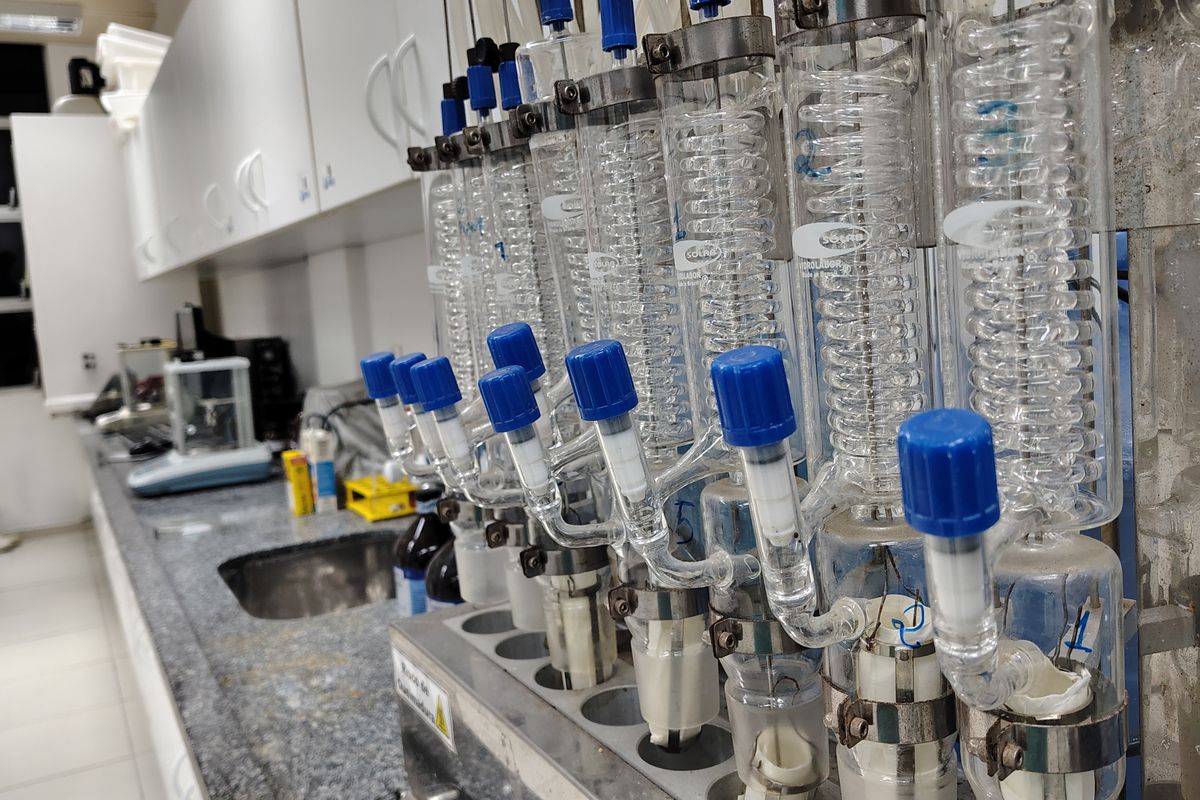
The chain is assembled while anchored to an insoluble bead, so every excess reagent can be rinsed away between steps. Illustration: Pexels
Almost every research peptide is built the same way. It is assembled one amino acid at a time, on a tiny plastic bead. The method is called solid-phase peptide synthesis, or SPPS. Robert Bruce Merrifield published it in 1963 and won a Nobel Prize for it in 1984. The machines have got faster since. The steps have not changed.
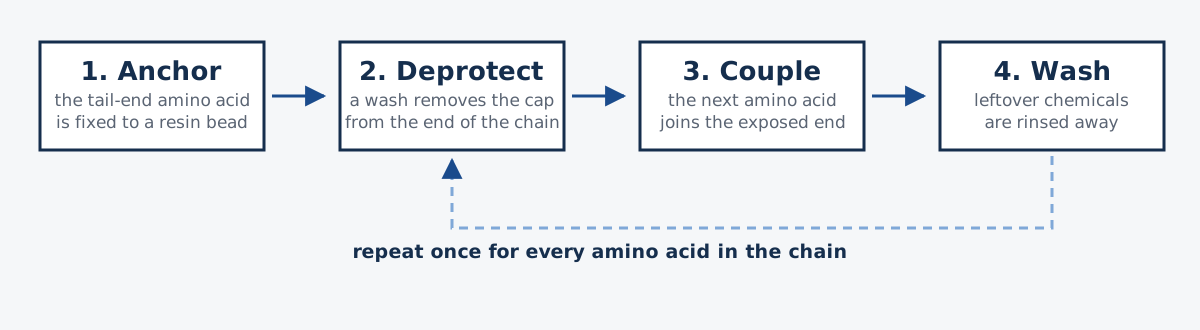
The cycle
The chain is built while anchored to a bead. Steps 2 to 4 repeat once for every amino acid. A longer peptide means more cycles, and more risk.
The trick is the bead. It never dissolves. So the chemists can flood it with reagents, rinse everything away, and leave the growing chain behind. That is what makes the whole process repeatable.
Anchoring. The tail end of the chain — the C-terminal amino acid — is fixed to a plastic bead that will not dissolve.
Deprotection. Each amino acid arrives with its N-terminal end capped by a protecting group, either Fmoc or Boc. A chemical wash strips that cap off and exposes the end of the chain.
Coupling. The next amino acid, switched on by a coupling agent, joins the exposed end. The chain is now one link longer.
Cleavage. When the sequence is complete, acid detaches the finished peptide from the bead. The same step strips the protecting groups off the side chains.
Steps 2 and 3 repeat, with a wash between them, once for every amino acid in the sequence. A twenty-link peptide means twenty passes around that loop.
Where the impurities come from
Coupling is never perfect. On each pass, a small share of the chains fail to accept the next amino acid. Those chains are not thrown away. They stay on their beads and carry on through the remaining cycles, permanently one link short.
The result is a deletion sequence: a copy of your peptide missing an amino acid from somewhere in the middle. This is the main impurity in most batches, and it is the hardest one to remove.
The reason is uncomfortable. A deletion sequence is almost the same weight as the target and almost the same shape. So it travels through a chromatography column at almost the same speed. It reaches the sensor at almost the same moment. So it tends to hide under the main peak instead of forming one of its own. That is exactly the blind spot described in what a 99% purity number does not tell you.
It also explains something that looks odd at first. Longer peptides are much harder to make cleanly than short ones. Every extra amino acid is another cycle. Every cycle is another chance for chains to fall behind.
Scope note
This article explains published research and the rules around it. It carries no dose,
no protocol, and no claim that any compound treats, cures or prevents a condition in
anyone. Where the evidence is thin we say so. See our
editorial standards.
KLOW is GLOW plus 10 mg of KPV — that part is simple. The more useful fact is that both are, by mass, mostly copper peptide, and that is the ingredient whose injected form has no human trials.
An open study found sleep normalised in six of seven patients. The controlled study by the same investigator found weak effects and said so. The difference between them is a placebo arm.
It does not raise dopamine — it magnifies what other things do to it. That one property explains why caffeine feels stronger on it, and why MAO inhibitors are a hard contraindication.
25 Sep 2026·8 min read
We use Google Analytics to count visits and see which articles get read. It is off until you
turn it on, and we do not use advertising cookies at all.
What we collect.